Showing posts with label Wines of Chile. Show all posts

Saturday, December 29, 2012

Wines of Chile: Masterclass

(attribution: http://starchefs.com/cook/features/chilean-wines)
Earlier this year I participated in a fairly extensive tasting of wines from Chile, organized by the Wines of Chile trade group. I've done these virtual tastings before, with mixed results. Chile remains a bit of an enigma to me (and my palate) because often the wines seem insipid, or in other cases, just poorly made, but then I'll taste several that are outstanding. To discount the country entirely would be an error though, because I am often impressed with Chilean sauvignon blanc, syrah, and pinot noir.

This tasting consisted of three sauvignon blancs, three pinot noirs, three carmeneres, and three cabernet sauvignons. The latter two having wines that were also blends in the flight. Pricing ranged from around $13 all the way to $65 for one of Chile's most famous wines, the Los Vascos "Le Dix" Cabernet Sauvignon.

I'm not sure how the wines were selected or by whom, but I know that Master Sommelier Fred Dexheimer was once again our gregarious, energetic host. He's being paid by the Wines of Chile trade group to promote their member wineries throughout the United States. Fred also makes a mean Pisco Sour. Representatives from each winery in the tasting were also on hand (via satellite) to discuss the wines and answer any blogger questions.

Unfortunately I've lagged on finishing this blog post. Still, I'm glad to share with you a tasting of twelve wines, white and red, from all over Chile. Instead of assigning numbers or grades to the wines, look for a simple "recommended" or "not recommended" after each tasting note. To explain, if I recommend a wine here it's because I feel it represents good quality-to-price ratio (QPR), tastes delicious, and is (relatively) flaw-free.

With that, I present twelve wines from across Chile's varied growing regions:

Sauvignon Blanc
1. 2012 Vina Casablanca "Nimbus" Sauvignon Blanc Casablanca Valley: Plenty of grassy notes mixed with citrus come rushing up out of the glass. They persist on the palate too, helped by plenty of crisp acidity. There isn't a lot going on in this wine but what does exist is proportioned quite well. If you need a versatile food white, pick up a bottle and see for yourself, it will pair with most anything. All for only $13. Recommended.

2. 2011 San Pedro 1865 Sauvignon Blanc Leyda Valley: Amping up the aromatics and mouthfeel (as well as the price), this beautiful sipper brings the same green grass note as in the first wine, but it's restrained by more citrus and hints of tropical fruit, considerably brightening up things. Plenty of acidity helps the wine move along across your palate, but it veers into the "bitter wine face" a few too many times. That disjointed nature dooms this sauvignon blanc for me. Not recommended. $19 SRP.

3. 2011 Casa Silva Sauvignon Blanc Colchagua Valley: Things start to get really interesting with this wine, and they should for $25 a bottle. It had some hallmarks of Sancerre, with the mineral and lime notes, but also a beautiful undercurrent of tart pineapple and other tropical flavors. I was impressed with the complexity and kept coming back to it as the night went on. Some of the other bloggers weren't too keen on it, but I felt that Casa Silva nailed the flavor profile for a cool climate sauvignon blanc without going too far into the gooseberry/cat piss side. Highly recommended.

Pinot Noir
4. 2010 Emiliana Novas Pinot Noir Casablanca Valley: My tasting notes refer to lots of fruit on the nose, with red cherry, strawberry, and hints of spice. I like how straightforward and unassuming this pinot noir is, but wish for more complexity. At $19, it's not expensive at all but I could pull a lineup of $20 Oregon pinots out that would blow this pinot out of the water. The finish was a bit short as well, but I liked the sheer "yummy" factor. Simple wine, yet tasty. Still, not recommended.

5. 2009 Cono Sur 20 Barrels Pinot Noir Casablanca Valley: My first bottle was corked so the Wines of Chile folks kindly sent another. This big, 14.5 percent abv pinot has some "interesting" attributes. On the nose there is a bit of alcoholic heat coming through. Also present, aromas of vanilla, earth, and red fruit. Where this gets tasty is after you take a sip. Plenty of tannin (odd, no?) frames bright red fruit, dusty soil, black pepper, and baking spice. The finish is clean and taut, indicating that this is still a baby of a wine. Yes, it's $32 a bottle but it has a lot of potential! Recommended.

6. 2009 Morande Gran Reserva Pinot Noir Casablanca Valley: I couldn't figure this pinot out. Aromatically it was like a red cherry jolly rancher mixed with eucalyptus oil and dried-out pizza box. On the palate there was plenty of acidity to keep things light, but that weird cardboard thing kept showing up. The bright fruit was nice and the herbaceous flavors kept things interesting. The bottle wasn't corked or suffering from brettanomyces, as far as I could tell. Not recommended. $17.99 srp.

Carmenere
7. 2010 Concha y Toro Marques de Casa Concha Carmenere Cachapoal Valley: Weirdly enough, this bottle was also bad, with something happening after it was made and before I received it. Another bottle replaced. On the nose there was oak and buttered popcorn aromas (diacetyl) that overlaid secondary aromas of sliced jalapeno. After sitting for about an hour, the wine calmed down quite a bit. Nicely integrated tannin helped along by some vibrant acidity enfolded flavors of green pepper, dried herb, red berry fruit, and wood. This wine desperately needs food, if you buy it. $22 srp. Recommended.

8. 2010 Carmen Gran Reserva Carmenere Apalta Colchagua Valley: Thin to the point of being delicate on the nose. More of that green aroma and some wood influences, but also notes of plum and cranberry. I can't say this wine was a tour de force of carmenere but I did like how food-friendly it was. Good acidity that brought high toned red fruit and spices along for the ride. A clean, quick finish that readied the palate for another sip, and a very nice price point. Just wish for more interesting flavors! Still, $14 is hard to beat. Recommended.

9. 2009 Koyle Royale Carmenere Colchagua Valley: A blend of carmenere, petite verdot, and malbec. Some bloggers loved it, I felt it was a mess. Too much VA (volatile acidity) to make any sense of what was going on. The people tasting with me felt it was downright unpleasant to drink. $25.99 srp.

Cabernet Sauvignon
10. 2009 Ventisquero Grey Cabernet Sauvignon Maipo Valley: Six percent petite verdot, the rest cabernet sauvignon. Seemed a bit undeveloped and too soft. What I mean by that is there wasn't much in the way of flavor integration, and there was a perceptible lack of tannin. Also, the wine simply didn't bring much complexity to the table. I re-tasted it several hours later and it had not appreciably developed anything interesting. I'm not sure if it was over-oaked or from young vines or what. For $29, there are far better choices to spend your hard earned money on. Not recommended.

11. 2010 Maquis Caberent Sauvignon Colchagua Valley: I tasted this wine several times over the course of the night and felt it opened up beautifully. The nose revealed aromas of cassis, spices, dried herb, tobacco, and oak. The more I swirled, the better all those aromas integrated, creating a wonderful tapestry. On the palate it was equally impressive, with plenty of tannin surrounding flavors of plum and black currant, tar, leather, dried herb, and cocoa. The finish was a bit quick, but I think this is a young wine that will get better with another year or two in bottle. For only $19, it nails the QPR quotient. Recommended.

12. 2009 Los Vascos "Le Dix" Cabernet Sauvignon Colchagua Valley: Don't drink this right now if you go out and buy it. My notes say "lots of potential.......I think". The ingredients are here for a great wine. Lots of tannin, flavors of leather, plum skin, tobacco, and cassis. Sound like a Bordeaux? Lots of stylistic similarities to young Haut-Medoc wines. The only question is whether or not all those flavors will merge with the tannin and acid to form a complex, compelling wine, or continue to stick out in jagged edges and at rough angles to each other. At $65, and with this producer, it's a pretty safe bet that in several more years, things will take a turn for the glorious. Recommended.

There you have it, 12 Chilean reds and whites to consider. It was a great walk through some of the regions and a fun opportunity to taste how the Chilean wine industry is coming along. I think they have a long way to go to become truly "world class" but there are very encouraging signs of progress. For my palate, the most promising wines coming from Chile are still sauvignon blanc, pinot noir, and syrah.

What I'd like to see wineries down there do better is manage volatile acidity, keep their cellars free of brettanomyces, and make better picking decisions to keep the pyrazine levels lower. There is potential too in the Bordeaux-based wines, in part due to the varied growing areas of the country. Right now it seems as if the Chilean winegrowers are finding out which grapes grow the best at which sites. To that I say, keep up the good work!

Thanks to the Wines of Chile trade group and The Thomas Collective PR firm for inviting me to taste along with my fellow bloggers.

These wines were media samples.

Beau Carufel

Friday, July 6, 2012

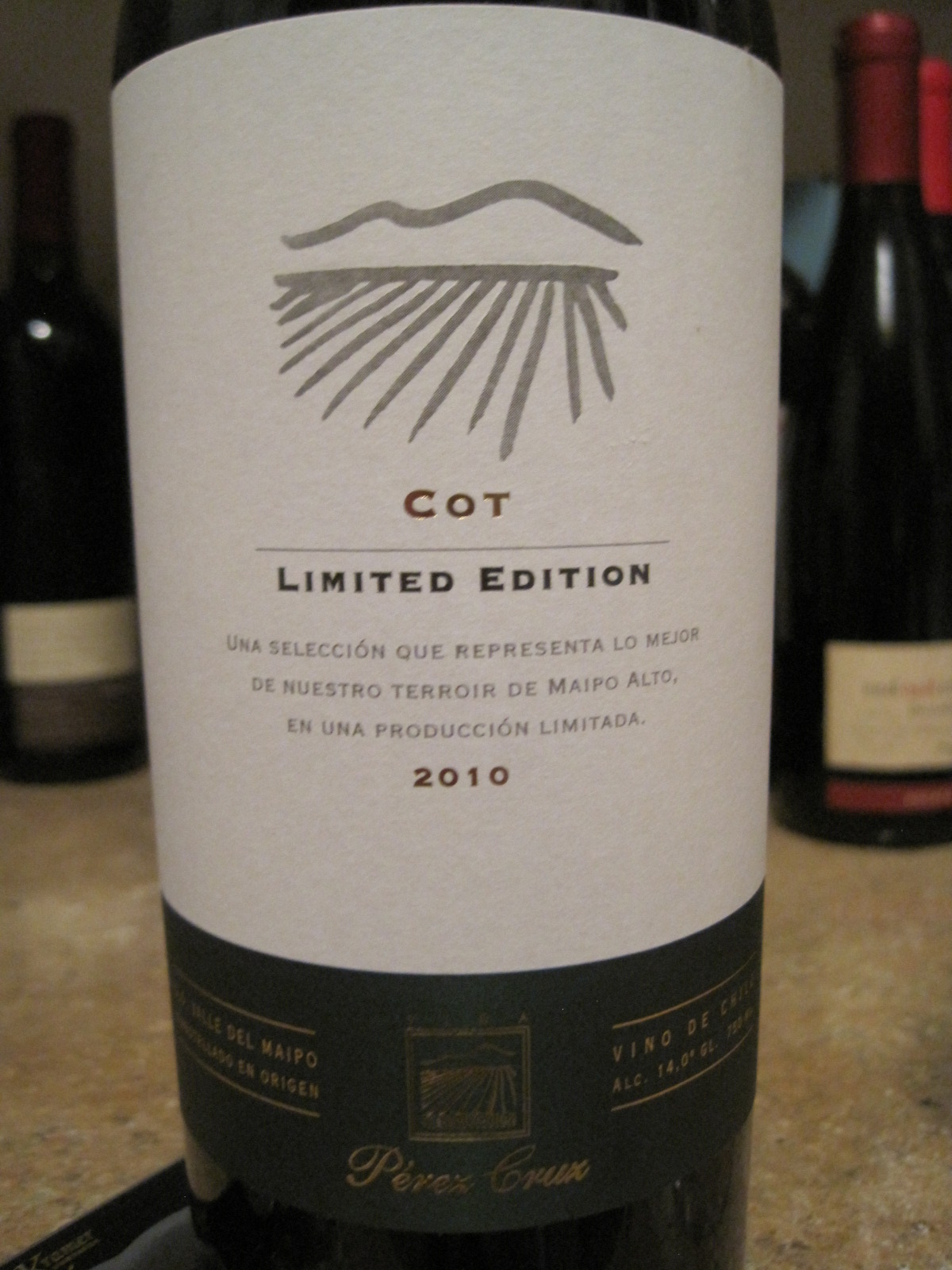
2010 Perez Cruz Côt (Malbec), Exploring Chile's Terroir

In an ongoing effort to explore the diverse soils and climates of Chile, I recently was sent a bottle of Côt (aka   malbec) by the Wines of Chile trade group. We'd been in contact since the most recent Wines of Chile Live Tasting that I blogged about, and I expressed interest in trying more Chilean red wines, especially those from unusual (to Chile) areas. They generously sent out a sample of the 2010 Perez Cruz Côt for me to try, and after waiting for about a month for it to settle down from shipping, I eagerly pulled the cork and dived in, so to speak.


2010 Perez Cruz Côt Limited Edition: While not 100% malbec,this is a blend of 93% Côt, 5% petit verdot, and 2% carmenere. Just goes to show you, Argentina isn't the only place outside of France for malbec anymore! The 2010 Perez Cruz pours a beautiful purple in the glass, that pales towards a nice ruby at the meniscus. The bouquet reveals itself after some vigorous swirls, offering notes of savory smoked meat, menthol, rosemary, and black fruit. I like this a lot better than the Argentine malbecs. On the palate it's offering flavors of leather, black cherry, more herbs, eucalyptus, and dark soil. The tannins are well integrated, holding the flavors together and creating a harmonious finish. 14.0% abv.

Based on the tasting notes, this isn't your typical jammy malbec from Mendoza, as you can tell. The Perez Cruz vineyards are located southeast of Santiago, right in the heart of Chile. From there, the warm, sunny days are mitigated by cool breezes which help rein in the sugar levels in the grapes while still allowing them to achieve phenolic ripeness. The region is called Maipo Alto.

At a suggested retail of $22, you get a very interesting malbec, with different characteristics from most New World examples. It's closer to a rustic Côt, from the Cahors region of France. For that alone, it's worth the purchase price. This would pair very nicely with steak, burgers, and Korean bbq. Look for savory foods to pair with this savory wine.

Here in the USA, it's imported and distributed by South American Wine Imports, so your local shop should be able to bring in a few bottles to try.

This was a sample from the Wines of Chile trade group.

Beau Carufel

Friday, April 13, 2012

Tasting Chilean Chardonnay and Sauvignon Blanc With @DrinkChile

I was invited to taste again with the Wines of Chile trade group, with whom I had tasted a variety of Chilean wines last year. The format, using Master Sommelier Fred Dexheimer as the moderator of a tasting session with winemakers and bloggers, was unchanged. At the studio in New York, he had a chef preparing some delicious looking seafood recipes to showcase these white wines. We bloggers were sent these recipes, I chose to simply taste the wines though, in order not to fill my apartment with distracting aromas.


Our theme this time was Coast to Toast, featuring white wines from the coastal areas of Chile.

1. Casa Silva Cool Coast Sauvignon Blanc 2011 Colchagua Valley: At first I said this wine was trying to be a New Zealand sauvignon blanc, with its green grass, gooseberry, and lemon zest bouquet. I still think it is, but also has taken on a Chilean twist. There's a note of briny ocean air to go with the aforementioned bouquet. On the palate, lemon zest and more asparagus. A clean mineral profile adds depth and complexity but isn't enough to overcome the lack of interesting flavors. 13.0% abv. $25

2. Los Vascos Sauvignon Blanc 2011 Casablanca Valley: A wine that for me started out dull and insipid, but grew into something vastly more interesting. While this wine isn't an extraordinary experience, I respect the fact that it is unpretentious and very quaffable. The nose is mildly astringent with notes of grass, grapefruit, and stem. On the palate the Los Vascos is dry, clean, and simple. More of the citrus with hints of asparagus and a nice bit of minerality. The very definition of crowd-pleaser. 13.5% abv. $14

3. Cono Sur Visión Single Vineyard Sauvignon Blanc 2011 Casablanca Valley: Way more lime juice than initially detected, some three hours in. Hints of minerality and a strange, not unpleasant lettuce aroma. Barely-there tropical fruits too. On the palate, bursts Meyer lemon, pineapple, and light grassy flavors dominate. The finish is really evaporative though, which disappointed me. 13.0% abv. $15

4. Viña Casablanca Nimbus Single Vineyard Sauvignon Blanc 2011: Earlier during the tasting I said this wine started to gently veer towards a Sancerre, and it still does three hours later. That stated, there are more cut-grass aromas now, pushing out some of the stone fruit and limestone I picked up before. This isn't a bad thing though because it gives the bouquet nice complexity. The mouthfeel is great, acidic and cleansing. Nice citrus - lemon zest to me - along with a kick of pear help this wine achieve lofty status as the best QPR of the night. 13.8% abv. $13

5. Veramonte Ritual Sauvignon Blanc 2011 Casablanca Valley: I kind of dogged all these wines when I first opened them. There was a stunning amount of homogeneity, but then I re-tasted and this Veramonte is making me smile. The bouquet is still sauvignon blanc, redolent of limestone overlaid with grass that someone squeezed a ton of limes over. On the palate, there's a smoothness here, a depth from the subtle oak treatment. Anthropomorphically speaking, it's like a girl who's grown up from a saucy teenager to a classy, Ivy League educated 20something. 13.5% abv. $18

6. Santa Rita Medalla Real Chardonnay 2010 Leyda Valley: Aromatically pleasing, think wet rocks and buttered popcorn co-existing with a bowl of sliced pears and apples. On the palate, light and kind of sultry, somewhat unexpected. Pears really show through, that and some grassy notes, even a bit of granitic mineral quality. My only knock on this wine is that it fades away awfully quickly. 14.0% abv$18

7. De Martino Legado Reserva Chardonnay 2010 Limarí Valley: This wine was very interesting, but not necessarily in a good way. I tasted it right after opening, when it had some acidity and flavors of tropical fruit. About two hours later, when I smelled it, I thought of rotting grass. Decidedly unpleasant, and this sharp, pepper-like note also showed up. On the palate it's relatively simple, peach and golden apple notes, acidity, but more of the strange rotting grass type flavor. Could very well be a bad bottle. 13.5% abv. $16

8. Concha y Toro Marques de Casa Concha Chardonnay 2009 Limarí Valley: I like the bouquet here, green apples mixed with cinnamon-spiced wood. There's a pleasantness this chardonnay has that keeps drawing me in. On the palate it's creamy but also balanced, the acidity shows up as a lemon and apple flavor. There's also noticeable oak here but it isn't in a bad way. In between the oak and citrus, a hint of tropical fruit - think papaya - shines through. A sweet, mineral-laden finish continues the intrigue. This chardonnay begs for king crab legs dipped in garlic butter. 14% abv. $19

What can we take from this tasting? First off, the wines we tasted were all interesting and while none were world class, all but one were very drinkable. Out of the lineup I did enjoy the Veramonte and Vina Casablanca bottles, and two of three chardonnays exhibited some pleasant characteristics too. If you are out and about, looking for an inexpensive bottle of wine that will pair with seafood or appetizers, buy any of these with confidence. The quality levels are high (save for the De Martino) and the wines are easy drinking.


From an educational standpoint, each wine showcased an area of Chile that can clearly produce high quality wines. As the winemakers in Chile gain experience with their diverse micro-climates, the onus will shift to the consumer to educate himself or herself and seek out specific regions. Personally, I enjoy syrah and sauvignon blanc from the Colchauga and Casablanca valleys, respectively. Others might love Maipo cabernet sauvignon or Maule Valley carmenere. It's so important to keep exploring countries like Chile because they're constantly discovering new areas that are conducive to grape growing.

Visit the Wines of Chile website to find out more information about the wines we tasted tonight, including some helpful links for where to purchase each one. Follow @DrinkChile on Twitter to learn more about Chilean wine and tastings in your area.

These wines were media samples for review purposes.

Beau Carufel

Friday, May 13, 2011

Chile Redux: Santa Carolina Carmenere

Right around the time that the Wines of Chile blogger tasting was going on, I was sent some samples from Santa Carolina as well. Things got rather hectic and as a result, those Santa Carolina samples sat in my wine fridge for a while, resting until I could start working through each bottle.

The first wine I opened was the 2009 Santa Carolina Reserva Carmenere, from the Rapel Valley. Priced at right around $10, it's a great entry into both Chilean wines and the varietal carmenere. My own expereicnes with carmenere to this point consisted of tasting the offerings from Concha y Toro's Casillero del Diablo, some Chilean wines with carmenere in them, and random tastes through my near-decade in the business. Suffice it to say that carmenere is not a varietal I experience often. Some of you are probably familiar with the Santa Carolina brand though, as it has been around for a while, producing all manner of red and white wines. Why would they then send out samples to bloggers? The answer lies in the new direction the winery is going. Starting in the very recent past, the Santa Carolina has begun to embrace it's heritage and history as part of a "Chilean Heritage" campaign.


After opening and letting the Santa Carolina carmenere breathe for an hour, I was ready to give it a thorough inspection. That's what wine bloggers are for, right? Carmenere is dark, very purple hued and opaque. At first glance, this reminded me of petite sirah or even zinfandel. For a long time, the carmenere was thought to be merlot and it wasn't "discovered" as merlot until 1994.

The first thing I noticed besides the color was that the wine had a potent, complex bouquet. I could smell specific aromas emanating from the glass despite it being a meter away from me. Lots of black pepper, earth, tar, and dried herbs jumped out at me. The Santa Carolina Carmenere bursts with aromatic intensity, and wafting up behind those primary aromas were hints of green pepper and blueberry preserves. In truth, I was surprised at how complex the nose was, I expected a more one-dimensional wine. Nothing like a pleasant surprise during a wine review, right?

A few sips in, I was impressed. Huge flavors of pepper, leather and a streak of minerality a mile long piled into my mouth. As I thought about what I was tasting, other flavors like mocha, bittersweet chocolate, and this rich, dense black fruit note put a smile on my face. The tannins here are very nicely integrated and silky smooth. To me, the Santa Carolina carmenere is ready to drink now but will also hold up for a few more years.

All told, a wonderful wine for $10 and something I'd gladly buy to have with grilled, charred meat. It is barbecue season after all! After poking around google, it's clear that the Santa Carolina Carmenere is available all over the country at places like Costco and your local grocery store. For further assistance finding the wine, Carolina Wine Brands USA is the place to check. My rating? Easily a B and a BUY recommendation. This is tasty wine and seems to be a wonderful expression of carmenere. I can't wait to try the rest of the Santa Carolina wines.

This was received as a media sample from Brand Action Team.

Beau Carufel

Thursday, April 14, 2011

Chilean Syrah and Pinot Noir Come to the Party in a Big Way!

Last night I took part in a tasting of Chilean cool climate red wines consisting of four syrahs and four pinot noirs. I posted a quick preview of the tasting here, before it got started. Today I'm recapping each of the wines I tasted and highlighting the ones I recommend you seek out. I'll also talk a bit about how the format went and where I think it can be improved upon for next time.

Instead of tasting with my usual crew, the (in)famous San Diego Wine Mafia, I figured I'd give them a break from my obscure tasting note references and host some friends at my place. I was able to bribe (free wine) my mom into cooking up some awesome food including fried pork chops in a port reduction glaze and an orzo-herb salad. My friend Beth came over and sauteed up some sliced portobellos sauteed in myrtleberry chutney. We also had an assortment of cheeses, a Mancego, Port Salut, and an aged Gouda.


1. 2009 Valdivieso Reserve Pinot Noir Casablanca Valley -- Beautiful light ruby color, nice clarity. Bouquet of mixed sour cherry and strawberry. some vegetal aromas, spice and smoky wood. touch of heat but it's barely there. all the aromas flow from one to the next very nicely in a linear manner. spicy cranberry and zippy acidity were the first two things i noticed when i sipped the wine. I could feel acid all over my palate, giving the wine a lighter feel. there is a core of ripe fruit mixed with earth and smoke that i do like, however the near-effervescence is distracting to me. Hard to ilke this wine right now. B- $17

2. 2009 Casablanca Nimbus Estate Pinot Noir Casablanca Valley -- Much darker than the first wine, closer to a Mendocino County zinfandel or California syrah. That intrigues me, I wonder how different the bouquet and flavors will be. Way more vegetal on the nose, black cherries and a plastic scent, smells like a hospital oxygen mask. The green scent overpowers most everything else though, however I can get a bare hint of dusty earth too. Much softer acidity and spices than the Valdiviseo and no green vegetal flavors at all. More round mouthfeel, spices, baking chocolate, chalk, black cherries. I like the mouthfeel a lot actually, would gladly have a glass of this with some food. B $20 **Smart Buy**

3. 2009 Veramonte Ritual Pinot Noir Casablanca Valley -- Very dark for a pinot noir, closer to a syrah-based northern Rhone wine. Smells like a funky Burgundy right off the bat. Also getting the quickest hit of red licorice and fennel. The funk is great, balanced by a sweet red fruit component. Much softer than the first two but with almots a white pepper heat in the background. Good complexity. Ripe red cherry, oak, spices, earth all playing nicely in the sandbox. Well done! B $20 **Smart Buy**

4. 2008 Cono Sur Ocio Pinot Noir Casablanca Valley -- Very nice garnet color, excellent clarity through the glass. Gorgeous bouquet! Candied cherry, teriyaki, dark chocolate, and smoke are all wafting out of my freshly swirled glass. Absolutely amazing. Granted for $65, it better be. Graceful approach that turns into the taste of sour cherry gummy worms, campfire and baking spice. The tannins are very approachable right now, framing the wine beautifully. Very, very high quality finish too, it goes on and on, gently tapering off after many seconds. Superb juice. B+/A- $65 **Recommended**

5. 2009 Tamaya Reserva Syrah Limari Valley -- Last night I referred to this wine as "fresh Krispy Kreme donut drenched in blueberry jam". Today as I stare at the color, an opaque purple, I wonder if the same thing will be true. To an extent, yes the blueberry and sweet aromas are still there but they have been supplemented by ripe blackberries and dark chocolate along with a bramble component leading into some alcoholic heat. This is a big wine, right off the bat it has spice, fine grained tannin, hints of leather and tobacco along with a crushed pepper flavor dancing around the fruits clapping along to the beat. While I can smell the 3% viognier in here, I cannot taste it save for what might be right on hte finish, a slight oily twist. The Tamaya is begging for fire roasted beef and grilled vegetables. B $17

6. 2006 Loma Larga Syrah Casablanca Valley -- I can't see through this dark purple concoction in my glass, wow! Smells like vanilla, fresh baked pastry and black pepper. Something fruity too, dark and ripe like a black cherry on a hot day. Earth and bittersweet chocolate are there but a little difficult to detect for my nose. Loads of meaty goodness are the first thing I taste, followed by more black pepper, forest fire mixed with dirt, and some nicely grippy tannins that help keep all those flavor elements in check. I wish for a bit more carry-through from the grapey fruit flavors, they seem to get covered up by the dirty wood smoke taste. This is perhaps a bit more rustic than I anticipated but it has it's charm, perhaps because of that. B- $30

7. 2009 Undurraga "Terroir Hunter" Syrah Leyda Valley -- The Undurraga looks lighter than the Loma Larga, a bit more of a bright purple than a darker, brooding purple. Here we go with ripe berries and cream, this reminds me a little of the Tamaya's nose from last night. There are more berry scents here though, blackberry, boysenberry and the like. More of the green pepper or green bean aromas are coming out as well. Even a hint of black cherry candy, very interesting! I was struck by the softness with which the Undurraga announces its prescence, nothing loud or overbearing. Hints of cinnamon and oak, chocolate, firm tannins and a streak of acidity that keeps the wine lively. I get the feeling that this saw enough time in oak to mellow out that acid but still keep the tannins from being too soft. B $25 **Smart Buy**

8. 2009 Hacienda Araucano Reserva Syrah Lolol Valley -- Very dark but appropriately so, this is syrah and looks like it. Sweet ripe fruit dominate, like a jar of mixed berry preserves next to some Balsamic vinegar. Again more of the hospital oxygen mask smell, easy to spot but hard to describe. Baked graham cracker crust is a cool new thing I rarely get from syrah. I was assaulted by loads of peppery spice and alcohol when I sipped and swished the Araucano, not quite a pleasant sensation. Despite that, I found good drying tannins, ripe black fruit and dusty earth notes. All very pleasant if my palate wasn't still reeling from the cudgel of pepper and booze that beat it into submission on the first sip. B- $14

A couple of things to bear in mind after you read through the reviews, each price is the suggested retail price, and I know the wines can be found for less. Also, I was told that all of these wines have nationwide distribution, the best place to start looking is Bevmo.com and Wine-Searcher.com. I've linked each winery website in the name, so you can search there to find a distributor list, if necessary.

After the tasting I used WineSave, so theoretically each wine was completely preserved until I pulled the corks today to re-taste. Trying to objectively taste, follow a chatroom, entertain guests, spit, tweet, and eat was just too many things to do last night. In the future I recommend the Wines of Chile people use a site like Tastelive so that our chat messages can be tweeted with a hashtag, saving us from having bounce between checking Twitter and the chatroom.


So to wrap this blog post up, I offer a few final thoughts. Each wine was well made and indicative of quality fruit. The styles varied widely, which helped me (and my palate) get a handle on what Chile is doing with syrah and pinot noir.

The ones I mentioned as smart buys are what I'd buy and enjoy. That doesn't mean the others were bad, just an indication of my palate preferences. Each is worthy of purchase and of enjoying a glass or two after a long day. Some though are going to be much better when accompanied by food, which I suspect might have been the goal of the respective winemakers. For example, a juicy steak or cheeseburger would pair wonderfully with any of the eight wines I tasted. The pinot noirs would be also wonderful with lamb and pork, while the syrah begged for venison, bison, or anything earthy and rich. This was the first Wines of Chile tasting that I was invited to and I had a great time, the blogger kits were extraordinarily well assembled and the wines were consistently good to excellent. I hope to be invited to more because as shown last night, Chile is producing wines that are on par with the best of the rest.

I was provided with these wines as a member of the press by The Thomas Collective for Wines of Chile

Beau Carufel

Wednesday, April 13, 2011

Wines of Chile Live Tasting - Preview!

Tonight is the Wines of Chile tasting, featuring eight red wines from all over the country. The event was organized by the Wines of Chile organization via The Thomas Collective of New York. You can follow along using the hashtag #ChileReds and the twitter account DrinkChile. A group of wine bloggers was each sent a tasting kit containing the wines and their tech sheets, background information on Chile, and some neat recipes to pair with each wine. The wines included in the tasting kit were:

1. 2009 Valdivieso Reserve Pinot Noir Casablanca Valley
2. 2009 Casablanca Nimbus Estate Pinot Noir Casablanca Valley
3. 2009 Veramonte Ritual Pinot Noir Casablanca Valley
4. 2008 Cono Sur Ocio Pinot Noir Casablanca Valley
5. 2009 Tamaya Reserva Syrah Limari Valley
6. 2006 Loma Larga Syrah Casablanca Valley
7. 2009 Undurraga "Terroir Hunter" Syrah Leyda Valley
8. 2009 Hacienda Araucano Reserva Syrah Lolol Valley


The "leader" of the tasting will be Fred Dexheimer, a Master Sommelier and founder of Juiceman Consulting, also based in New York. His involvement tonight stems from his work as an educator/consultant for the Wines of Chile program. Also joining in will be Matias Rios Langevin from Cono Sur.

Along with the Chilean wines, I've gone ahead and cooked up a few dishes (with the assistance of my Mom, a Cordon Bleu-trained chef) including an Orzo & French Lentil salad with fresh herbs, pork chops with myrtleberry chutney, and my friend Beth is bringing over some mushrooms to sautee in butter and herbs.

While I have no idea how many bloggers are taking part, last time I did a Chilean wine online tasting, a lot of people "showed up" and we had a lively discussion. Tonight will be no different, I suspect. The tasting starts in about an hour and I know that I can't wait to get started. While opening each wine, I may or may not have taken the opportunity to sniff each bottle repeatedly, as a result I'm very excited. The aromas ran the gamut from barnyard, gamey notes in one of the syrahs to fresh crushed summer berries in a pinot noir.

 My experience with Chilean wines has been at either the very low end of the price spectrum with wines like Casillero del Diablo or at the top end with amazing wine like the Concha y Toro Don Melchor. Being able to taste through this mid to upper tier group of wines will help me learn a lot more about what Chile is capable of and more so, what Chile is bringing to market right now. All the wines are pretty widely available, evidence of a good job by the Wines of Chile group. After the tasting, I'll be assembling my tasting notes and more pictures to present a comprehensive overview of what I tasted and what I recommend you go out and buy. Stay tuned!!

Beau Carufel