Showing posts with label Champagne. Show all posts

Thursday, June 5, 2014

Arteis & Co. Champagne, 2002 Extra Brut

Champagne samples are a rarity for me, and I suspect for most bloggers, save for the "elite". A few weeks ago I was contacted by the PR agency representing Arteis & Co. reached out to me to see if I wanted to try one of their Champagnes. Anyone that knows me know I drink a lot of Champagne, usually at least two bottles a week. And I mean Champagne from the region of Champagne, not method traditionelle sparkling wine or cremant from other places in France. Remember, if it says Champagne on the label, make sure it's actually from there and not a poseur from someplace else.

Arteis & Co. debuted their wines last year in New York restaurants, and for a time were only available there. Now, the company is releasing more additional wines and expanding distribution to Los Angeles and San Francisco. As of this writing, the Champagnes are not available at retailers, just high end restaurants in those three cities.


After a few back and forth emails between the PR firm and myself, a sample bottle of the 2002 Blanc de Blancs Extra Brut made its way out to Oregon for me to taste. I wasn't sure what to expect, as this is a brand I have no knowledge of. I was worried that what I'd be tasting was a gimmicky, poorly made Champagne that was created by some huge winery and marketed as "true luxury" or some such thing.

Luckily, I was wrong.

I chilled the 2002 Arteis Blanc de Blancs (100% chardonnay) for a few hours before serving it, but also made sure to pull it from the fridge about 20 minutes before we popped the cork. It poured a beautiful pale gold with green flecks throughout. On the nose, correct mature notes of brioche and red apple helped show more vibrant aromas of lime, wet chalk, and subtle peach blossom. As we all tasted it, eyes widened and lips curled skyward in big smiles. I think this is flat-out delicious Champagne. It's showing a beautiful aged quality that acts as a lovely foil to the freshness. Apples and pears galore on the palate, with supporting flavors of lime and chalk dust, as well as a subtle yeasty component that we all loved. The finish is crisp and clean, with a nice taper that lasts a solid 10 seconds, once again showing wonderful vitality despite the 10+ years of age.


I'm confident in say that this is the real deal. If I ordered a bottle off of a wine list and it tasted like the sample bottle I received, I'd be thrilled. According to the PR firm, the pricing (at restaurants) is $300-350, but that'll vary by location. I have inquired about the availability at retail locations, where the SRP is $129, but as of now the wine is not available outside restaurants. Hopefully that changes soon, as I believe that those of us who love vintage Champagne would enjoy adding this to our cellars. I give it a Highly Recommended and urge you to keep your eyes open for Arteis Champagnes.

Artéis & Co. is imported by Riahi Selection
in New York, H. Mercer Imports in California
, and Wine Collection in Florida. For more information, please visit www.arteis.co.

This wine was a media sample for review purposes.

Beau Carufel

Tuesday, January 15, 2013

Why So Quiet?

This blog has been quiet lately, with the blame falling squarely at my feet. After months of relative inactivity, punctuated by the occasional post, I decided it is time to talk a little bit about what has been keeping me busy as well as sapping my energy to post blog entries on a more regular basis.

This October, I started making wine for the first time. This is the real thing, and will be released as a commercially sale-able product when ready. I had initially picked roussanne and mourvedre to work with, but ended up with neither this year. The mourvedre was already allocated to people higher on the grower's customer list than I (typical and completely fair in this industry). The roussanne I so lusted after ended up being lost to Mother Nature, as the relentless summer sun caused the vineyard to lose around half its yield. What remained went to prior customers.

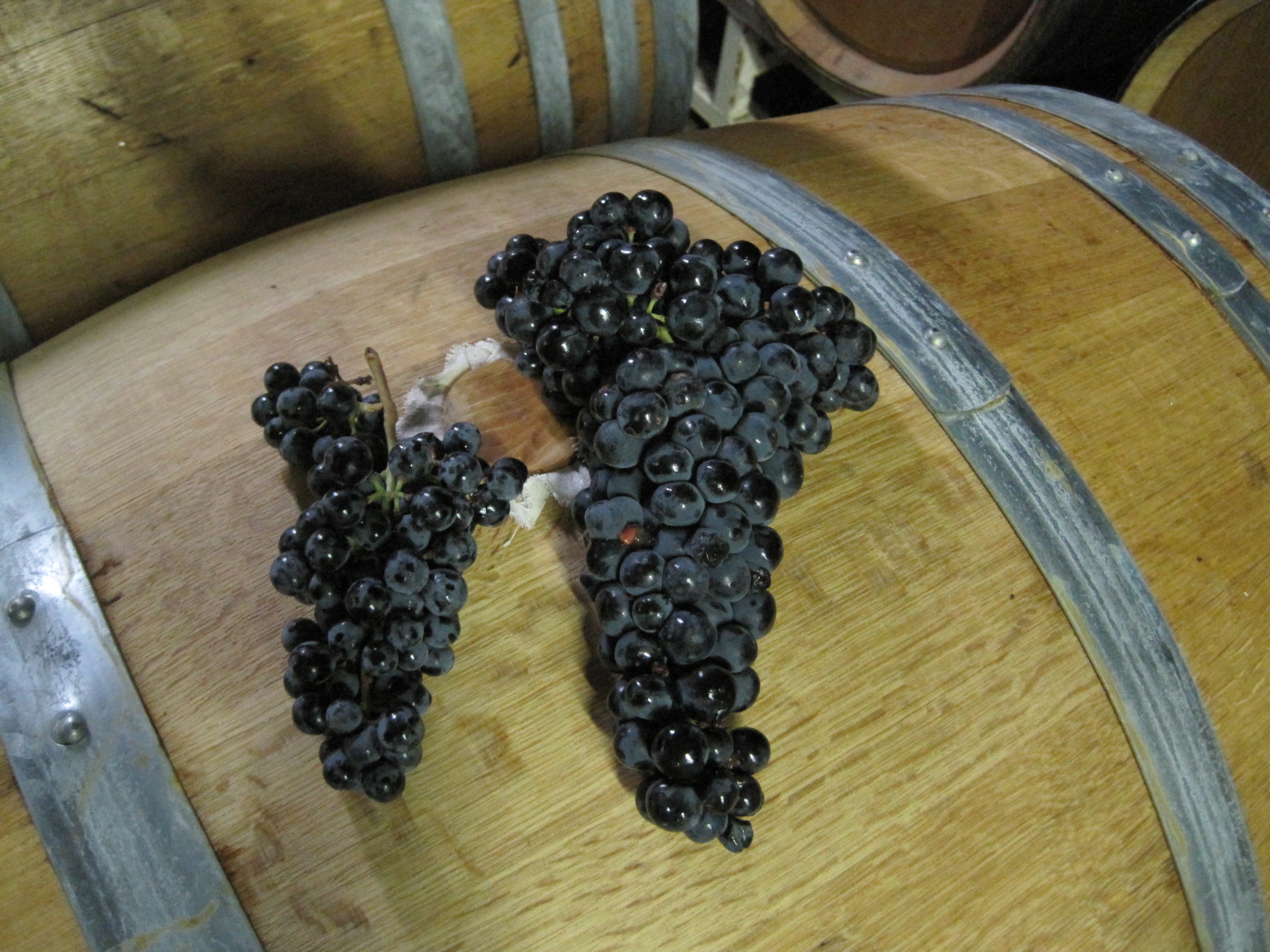
I ended up with petite verdot and tempranillo, two grapes I am thrilled to be working with. Total intake for 2012 was .82 tons of petite verdot and 1.1 tons of tempranillo from the Horse Heaven Hills AVA south of Prosser, Washington. The clusters on each were absolutely beautiful, with minimal raisining, no rot, and hardly any bugs!

Fortunately for me, I had a lot of assistance from the Kramers, especially Kim, in walking me through the process of selecting yeasts, must treatments (or lack thereof), barrels, and much more. The Kramers also helped with the nitty-gritty, punching down and pumping over the fermenting bins when I was away at my day job.

The day job. I began to look for another job in mid-July, when I realized I was not a good fit for Cathedral Ridge. To succeed in the wine business you must be passionate about the wines you are selling, and I simply couldn't find that passion. In September, I went to work for a distributor here in Oregon, working the Portland Metro area, selling Pacific Northwest wine and craft beers. The job is great in many ways, offering good compensation and benefits, while challenging me to see how far I truly want to go in sales. Each month I am amazed with what I've learned about selling for a distributor, and I'm taking away many things both good and bad from my experiences.

The last week of September saw me in Bordeaux with a group of wine bloggers including Jameson Fink and Joe Roberts. Balzac Communications and Planet Bordeaux were generous enough to include me on this trip, for whatever reason. I confess that despite the incredible experiences I had, I struggle to write about my time there. Whenever I begin to write about Bordeaux, I get frustrated that my writing skills aren't enough to suck you in, dear reader. You will see more Bordeaux posts from me in the future though.

2012 ended with a flurry of activity, and I proudly proclaim that in the last six to eight weeks of the year, I drank more Champagne than I ever have before. A rough guesstimate puts it at a case and a half. As you can tell, I am quite proud of this factoid.

What does 2013 promise then? The search for new grape sources. I haven't given up on my dream of working with grenache, and I may have a source for some of the finest domestic cabernet franc grapes, period. White wines also call to me, to that end I am actively seeking white Rhone varieties and sauvignon blanc. I hope that my Tempranillo will be released this fall, and that the petite verdot will be released in spring of 2014. Hope is just that, because as we know, the wines themselves will decide when they're ready to be released.

2013 also will bring some changes to this blog, when I move away from reviewing wine and more towards just talking about cool wines I drink. To my PR/Media friends, I'll still accept samples for review, but not nearly as many as before. I'm tired of all the crappy wines and Becky says they take up too much space in our house. She is right.

My personal journey with wine will see me buying more aged Bordeaux and Burgundies as well as continuing to explore Champagne, Alsace, and the Rhone Valley. Of perhaps some interest to my readers, I'm also embarking on a quest to find California Pinot Noir that my palate enjoys. After nearly a decade in California wine sales, I tasted most of the big name, "cult" pinot noirs, and can't stand them. The search is on for cooler climate, higher-acid, restrained examples of what the state can do. Of course, this will limit my search to more recent vintages, but that's ok.

Here now I ask you, did you make any wine resolutions this year? Did you have any wine epiphanies last year?

A toast to 2013, thank you for reading along!

Beau Carufel


Wednesday, May 16, 2012

Domaine Carneros, by Taittinger

(img src: www.luxist.com)
The wines I'm writing about in this feature were originally to be part of an Easter article, suggesting you pair sparkling wines with your Easter meal. Unfortunately due to a shipping mix-up, the wine didn't arrive in time.

Allow me to clarify though, sparkling wine should be enjoyed year-round. It's always a good time for bubbles.

Fast forward several weeks and I had occasion to open the 2005 Domaine Carneros Le Reve Blanc de Blancs and NV Domaine Carneros Cuvee de la Pomadour.

Our good friends Lars and Dave were celebrating their wedding anniversary and stopped by on their way home to say hi and catch up. Seeing as we get together all too infrequently, I decided that we were going to open a special bottle of sparkling wine and chilled the Le Reve immediately. Knowing its provenance, I anticipated a wonderful experience for us on that special day.

Domaine Carneros is owned by the famous French Champagne house Taittinger, which was founded in 1734 in the city of Reims. Over the years it has established a reputation as one of the foremost Champagne producers in the world, so when the Taittinger family started Domaine Carneros in Napa Valley, there was considerable expectation put in place. That was back in 1987. Since then, the Taittinger family has always exerted a light touch, allowing CEO/Founding Winemaker Eileen Crane to go about her pursuit of great sparkling and still wines with considerable freedom.

The selection of Carneros in Napa Valley was no accident either, and the region is now home to many of California's most admired pinot noir and chardonnay vineyards. As of now, the estate produces six sparkling wines, all done in the methode champenoise style. Methode champenoise means that the wines are made the same way as in Champagne, with the wine undergoing its secondary fermentation (the one that produces the bubbles) inside the bottle. That's the quick way explain, but there are many other factors that make this method unique when compared to others such as carbon dioxide injection or the Charmat Method.

How were the wines, you might ask?

2005 Domaine Carneros "Le Reve" Blanc de Blancs:
Beautiful aromas of lemon peel, brioche, red apple, and bracing minerality. This is 99% chardonnay and 1% pinot blanc. On the palate it's creamy and smooth while retaining a pleasing lightness. Flavors of cake frosting, golden apple, spiced lemon slices, and a yeasty richness emerge from the bubbles. The complexity is what you'd expect from a wine with this provenance, in a word: impeccable. That said, I'm equally amazed with the integrated flavors, a testament to the vintage and time spent on the lees. After each sip I reflected on how much it felt like a complete experience, so good was the balance. One of the best California sparkling wines you can buy, period. $95 SRP.


NV Domaine Carneros Cuvee de la Pompadour Brut Rosé:
This wine pours a beautiful rosé color, and when held up to the sun it reminded me of bright, shiny copper reflecting the sunlight. A beautiful bouquet of flavors wafts out of the glass, among them strawberry, brioche, hints of orange zest, and a lovely, delicate potpourri. While not quite at level of the Le Reve, this rosé (58% pinot noir, 42% chardonnay) does have a fine bouquet. On the palate it's light and dry, with plenty of tart red fruit and citrus, lifted by vibrant acidity. Fine, delicate bubbles create a lovely textural sensation that only ends many seconds after you swallow. Again I found the balance of flavors to be excellent. For a brut rosé, this is a wine I'd happily pour for a group of Champagne lovers, blind. At a suggested retail of $45, but available at $35, it's half the price (or more!) of brut rosé Champagnes.


Both of these sparkling wines were excellent, and much to my delight, neither showed any signs of oxidation. This is a testament to good winemaking, as well as perhaps indicative of the committment the Taittinger family has to making Domaine Carneros the best sparkling wine producer in the United States. With wines like these, I suspect they're close to accomplishing that goal.

For the 2005 Le Reve, I'd suggest pairing almost anything with this wine, short of a steak. I'd have enjoyed some oysters, lobster, caviar, or even more humble fare like fried chicken and french fries. Honestly, the wine would have been amazing even with a pizza. For the Cuvee de la Pompadour, I'd have paired it with grilled shrimp or chicken, anything fried, or even some berry sorbet.

These wines were media samples for review purposes.

Beau Carufel

Thursday, March 10, 2011

Champagne versus The World: Part IV..Champagne Brings Reinforcements!

Apparently more than 40 renowned chefs, sommeliers, and wine educators just sent an open letter to Congress, asking for the body to address mislabeling of wine bottles. Specifically, the labeling of American sparkling wine as Champagne, when it is not in fact Champagne. This somewhat contentious issue has been going on for five years now, since the U.S.-E.U. Wine Accords were signed in 2006. I know Congress has a reputation for dragging its feet, but that's rather amazing.

According to the Champagne Bureau, the region's trade group here in the States, 50% of sparkling wine sold in the United States is still mislabeled. The point of contention here is the use of Champagne on sparkling wine that isn't from the actual region of Champagne in France. In the brief press release that appeared in my inbox this morning, the Champagne Bureau also reported on other countries efforts to end mislabeling. Notably, Australia is going to phase out all mislabeled Champagne and Port by September 2011.

Why is the United States dragging its feet on this issue and perhaps more worrying, why is the wine industry in this country not voluntarily removing Champagne from its sparkling wines? I know a great many producers have ceased using the word, or never used it in the first place, but why does Korbel for example still insist on using it? Perhaps it's my cynical nature but the first word that flashed into my brain was "MONEY". The recognizable word carries certain connotations and those are great sales points for a sparkling wine.

A condition of the Wine Accords was the grandfather clause that allowed wineries who had been using Champagne on their labels for something like 20 years or more to continue using it. Wineries are hiding behind that clause five years later. I'll say right now: it's flat out unethical to use the word Champagne on a wine that isn't from Champagne.

Can you imagine the furor if all of a sudden, some cheap Italian or Languedoc wines start calling themselves "Napa Blend" or "Meritage"? In our litigious society, lawsuits would be filed faster than Charlie Sheen on a four day bender. Americans would cry foul, accusing European wine producers of playing off the good (great, even!) name of California wines in an effort to deceive customers and poison the world's water supply. Wait, I think I got my James Bond plot mixed up with my nefarious-mislabeled-wine plot.

Yet we have plenty of wineries here in the U.S. that continue to use Champagne, arguing that it's become synonymous in the consumer consciousness with sparkling wine. They're right, every day I get people asking for "Champagne" who then want something cheaper, i.e $5 versus the $20 that Champagnes start at. I think most consumers also know that real Champagne is French and if you tried to sell them something like "California Champagne", they would happily accept (because it's cheap, duh!) but might wonder how it's different than the French example.

Wine education is perhaps the key and the Champagne Bureau needs to understand that. I bet 99% of my friends and family have no clue who any of the over 40 wine professionals are that sent the letter to Congress. Yet out of all my wine drinking friends, I can easily state that more than 75% would love the opportunity to taste and compare Champagnes and other sparkling wines side by side, as well as learn more about why Champagne is unique. Therefore my question is this: how is the Champagne Bureau reaching out to local wine stores to encourage a consumer education campaign?

As for me, I'll buy sparkling wine and Champagne interchangeably depending on how much I want to spend at the moment. For my dollars, Cava from Spain is the supreme value sparkler and California delivers some outstanding sparkling wine at lower prices than Champagne producers charge. That might also be something the Champagne Bureau should look into...

Beau Carufel

Monday, January 17, 2011

Tasting Sparkling Wine With The San Diego Wine Mafia

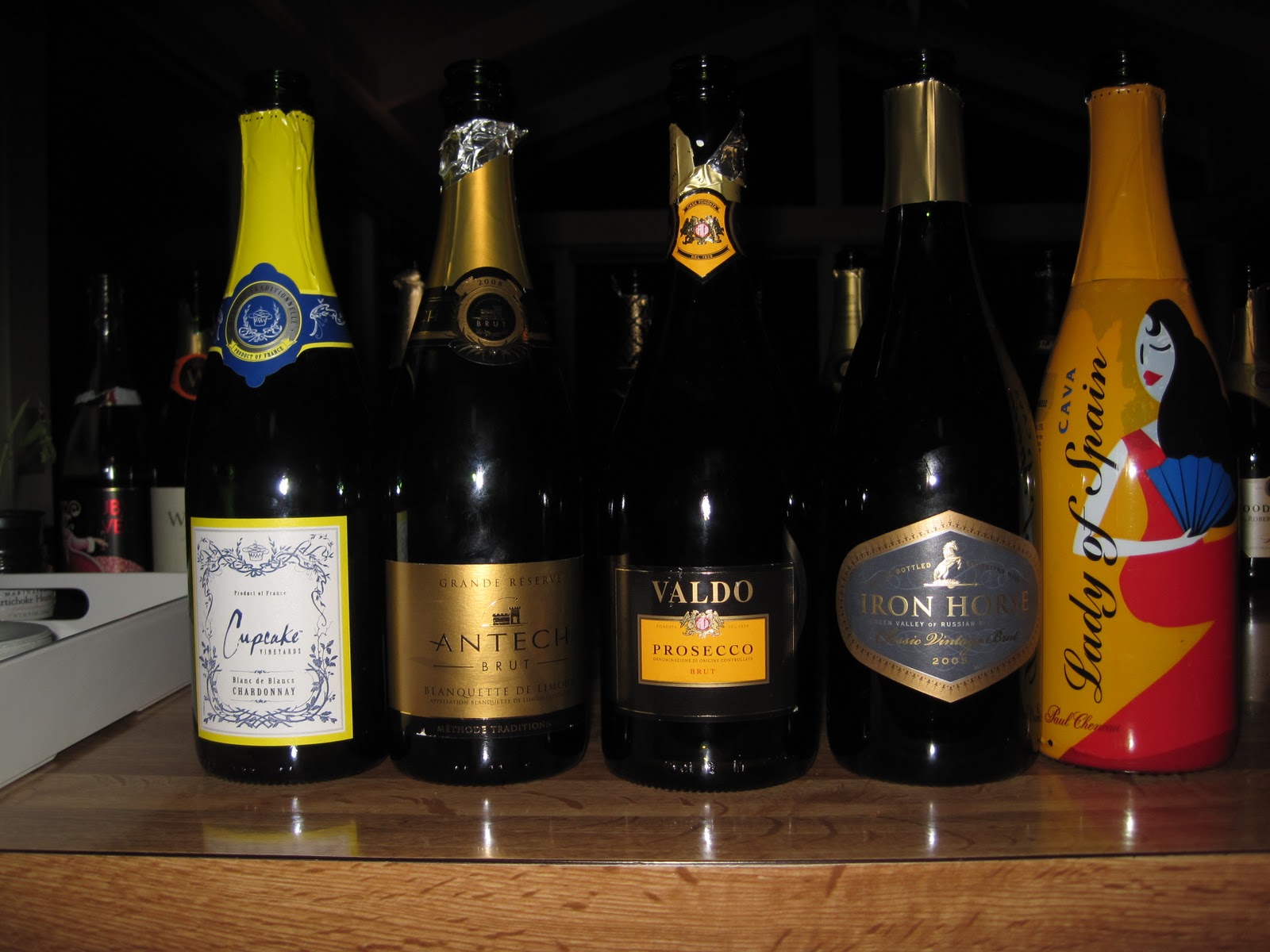
Last month the San Diego Wine Mafia held our first ever sparkling wine tasting. Harnessing the power of Twitter, we were able to get a great lineup of bubbly wine (to go with our bubbly personalities of course!) and each member contributed some food to pair with said sparkling wine. While we were able to accumulate 22 bottles from France, Spain and the United States, I think it would be pointless to list each one with the accompanying tasting notes. That and there were multiple bottles of sparking wine that I just didn't like. However, the San Diego Wine Mafia did taste a bunch of winners. At it turned out, the prices of our favorites ranged from $8 to $95 and from the Columbia Valley to Champagne itself.


Here's a list of my favorite sparkling wines of the night:

Delamotte 1999 Blanc de Blancs: Well balanced, veers a bit towards florals, hints of yeast, luxurious as all get-up.
A- $95

Domaine St. Michelle 2004 Luxe: Fresh baked apple tart on the nose, I dig it! Good balance of acid and creamy yeast on the palate. Washes clean with subtle apricot on the finish. Delivers above it's price point.
B+ $18

Domaine St. Michelle Brut:  Very traditional flavor profile, totally loved the interplay of dryness and fresh baked bread. Great acidity and bubbles, nice hints of yeast. What a QPR killer!
A- $8

J Brut Rose: Nicely fruity with raspberry and strawberry wrapped in leather. A classy dominatrix? Yea I dig it, but not the price. While I love pink sparkling wine, I'm still trying to figure out the California examples.
B-  $30

Paul Cheneau Blanc de Blancs Cava: Nice nose, great flavors of citrus and hints of apricots. Great acidity that carries through to the finish, really happy with this one. Not a QPR-buster but you get a delicious wine at a good price.
B+  $17

Mumm Napa Brut Rose: Another California rose, one that is solidly made, great balance of fruit and acidity. You can tell it's got Pinot and that is a damn good thing. One of the better rose sparkling wines I've had lately.
B+  $18

Woodbridge Brut: Nose brings the funk, palate has some awesome yeasty notes but also fruit notes, rich, really nicely done. Delivers above it's price point and far, far above it's label. This is why I love blind tasting!
B+  $10  

Iron Horse Classic Vintage Brut 2005: Well done! Impressive balance between bubbles and bright acidity, wish there was more of a nose though. Still, a nice effort and the fruit shines through the mid palate then carries the finish. I'd drink this any time, it delivers for under $30.
B-  $27

I want to say thank you to all the wineries and PR groups that sent us sparkling wine, the response was wonderful! I'm deeply appreciative that I was able to taste so many sparkling wines in one session. The prices quoted here are either the Suggested Retail Price or the price I found on the winery website. Often they're available for a bit less at your local fine wine shop.

Beau Carufel

Tuesday, December 21, 2010

Jaume Serra Cristalino Brut Cava, Wonderful and Inexpensive!

 (img from http://www.blogyourwine.com)


Cava. Spanish sparkling wine made in the traditional method. Elaborating further, the "traditional method" means that the secondary fermentation (where the bubbles come from) takes place in the bottle. Said bottle is then aged, Spanish rules for Cava requiring a minimum of nine months. There is no "Cava" in Spain, the word means "cave" and refers to the caves which were (and still are) used to age Spanish wine, both sparkling and still.

Right now the demand for Cava is soaring, mainly because it delivers good quality at a great price. This compares to Champagne which often delivers good quality at a high to "OH MY GOD" price. The Cava I was sampled on has a new label, one that states this Cava is in no way related to the Cristal Champagne made by Louis Roederer. I can see how people would get confused, because the bottles look so similar and the difference in price is only $10 for the Jaume Serra and $250 for the Cristal. Still, the legal eagles at Roederer didn't want their brand's image sullied by a high-quality-just-not-expensive sparkling wine so they sued. And won, as it were.

The Cristalino Cava from Jaume Serra comes from fruit sourced via contracted local growers and the estate's own vineyards. Jaume Serra's roots go back to the 17th century, so they've been making wine for a long, long time. Within the Penedes region, the grapes Macabeo, Parellada and Xarel-lo are used for Cava wine production. Penedes is in Catalonia, the region of Spain just south of Barcelona, the city which held those lovely Olympics back in the Summer of '92. Forget that I was nine years old, wasn't the original Dream Team cool?!

Have I held your attention until now? Hopefully the answer is yes, because now we get to talk about how the Cava tasted!

I chilled the Jaume Serra Cristalino in an ice bucket for about 30 minutes prior to opening, not because it helps me taste better but because I prefer my sparkling wines to be cold. In the glass, a pale golden color with medium bubbles, clear and looking delicious.

Clean citrus on the nose, like a faint whiff of lemon cream tarte and a bouquet of flowers. I admit that for a lot of us, smelling a sparkling wine and getting more than two or three main flavors is tough. Or it is just tough for me to do and I'm trying to feel less inadequate as a blogger. Take your pick! Back on topic, I liked the nose, a lot. There was no complex orange peel mixed with bread dough and hints of star anise there, just a lovely floral note and the citrus, for me lemon tarte.

I sipped a few times before jotting down my impressions, that often happens with sparkling wines because I like to let the effect of the bubbles dissipate a bit. This wine was creamy and rich across the front palate with a very nice finish, it is just dry enough to leave you wanting more but at the same that ripe, rich sensation gives the Cava some depth and complexity. Good interplay between the acidity and body, which I'd characterize as a yeasty note. That's a good thing by the way, something I really enjoy in sparkling wines.

So my conclusion was the Jaume Serra Cristalino is an accessible, very tasty Cava. I gave it a B+, strong BUY recommendation. For under $10, you can't get much better and I look forward to tasting more sparkling wines in 2011. I recommend this as a good accompaniment to those massive plates of holiday hors d'oeurves that are a common sight at holiday parties. If you're sipping this without the party, try pairing it with potato chips (I kid you not!) or..get ready for it..fish tacos! Seriously, I got a couple of fish tacos from the place up the street from me and it was wonderful! Just don't put spicy salsa on the tacos, try the green salsa.

This wine was received as a sample for review purposes.

Beau Carufel

Friday, November 12, 2010

Making Sense of Turkey Day Wines


Gobble effin' Gobble.

Thanksgiving seems to put a normally sane, rational person into a state of mental (and often physical) paralysis. My belief is the logistics of this oh-so-American holiday have become overwhelming because as we're so wont to do in this society, Thanksgiving MUST be a GIANT CELEBRATION!!!!


I must respectfully call b.s. Perhaps not even respectfully so. Those of you who are reading this and are considered the "wine expert" or "wine guy/girl" in your circle of friends know all too well that around this time of year, the "what wine should I pair with Thanksgiving" question creeps back to life like a zombie in Shaun of the Dead.


Lots of experts and "experts" will tell you all sorts of cool wines to pair with your Thanksgiving meal. Wine Hipsters, those smug denizens of New York City wine bars, trade tastings, and San Francisco restaurants will suggest off-beat, funky wines that you have no chance in hell of ever finding. Stuff from some random obscure producer in the Loire Valley that makes 2 barrels of amazing wine, of which somehow seven 3-packs make it to the States.

Even better, you can listen to the cacophony of voices espousing the "Natural Wine" way of life. Who doesn't want an un-sulfured 2010 Viognier/Pinot Blanc/Marsanne blend that's just come 2200 miles across America's highways while still fermenting? Yummy! Who needs racking and barrel aging when you have potholes and brake-checks?


My point is this: on Thanksgiving, simplify the wines you choose! Let's face it, is there any one, singular flavor you'll be assaulting your palate with on the Big Day? I doubt it, and therefore trying to pair a wine with each dish or opening that crazy/unique/rare bottle will get tiresome and frustrating. My advice is to pick three wines, and get multiple bottles of each one.


Here's my short-list:

1. Sparkling wine: This could be some delicious grower Champagne or some German Sekt, or even a cheap Cava. Of course, I personally prefer the dry flavors of a Brut Champagne but if YOU like sweet, go with sweet. Bubbles are the key, they'll keep your palate fresh while the alcohol will help you and your guests chill out a bit. Keep multiple bottles of whatever you pick on hand and serve it when guests start arriving, a nice mellow tone to start the night will lower your stress levels.

2. White wine: I'll get flack for this, Wine Hipsters will roll their eyes and bloggers will castigate me via Twitter, but I suggest a Fume Blanc/Pouilly-Fume or Riesling. Keep the white wine simple, chilled and accessible to all your guests. For the vast majority of people, the stress of wondering whether your special bottle of Norwegian Roussanne/Gewurztraminer will work with potatoes au gratin just isn't worth it. With the Fume Blanc or Pouilly-Fume, that nice kick of acidity that's been softened by a bit of oak will work with a lot of the veggie dishes and can stand up to some of the creamier sides. An off-dry Riesling will add some fun with it's sweet but light blend of flavors. If you cook a turkey that has herbs added, the pairing will work with that too.

3. Red wine: I can sense the sharpening of attack-talons now, the jeers are going to rain down..Or worse, this entry will get relegated to the "that guy's full of shit" blog heap. Pinot Noir or Zinfandel. Either of these will work beautifully provided they're well chosen. Since the average Thanksgiving guest cannot taste the difference between a $740 Grand Cru Burgundy and a $90 Willamette Valley Pinot, why even worry? Grab two or three bottles of something that costs about $40 a bottle and you'll be getting some delicious juice. For Zinfandel, try to avoid a jammy fruit-bomb from Paso Robles, instead check out some stuff from Mendocino or Sonoma Counties. $30-40 gets you a slam dunk Zin that stands up to the turkey, stuffing and sweet potatoes yet doesn't leave you feeling like you just inhaled mixed-berry jam from Smuckers.

The Thanksgiving that most of us...no the vast majority of us will celebrate will have a mix of wine fans and those who drink it because there's alcohol in it and everyone else is doing it. We who love to explore wine need to realize this and accept it. There are 364 other days in the year to explore new and interesting wines, so calm down with the Thanksgiving madness, take a deep breath, and just enjoy the way wine brings people together.


No turkeys or zombies were harmed in the making of this blog.

Beau Carufel