Showing posts with label #WineChat. Show all posts

Wednesday, August 20, 2014

Tasting Hyland Estates Current Releases

Once again I was invited to do a live Twitter tasting (shall we just call them LTt's?) but for a change, the winery featured is local to me. As many of you know, every Wednesday on Twitter, from 6-7pm PST you can use the hashtag #Winechat and see a passionate group of wine lovers chatting, usually with a fairly specific topic. It's a great way to learn about wine while connecting with people from around the world.


Hyland Estates, located in the McMinnville AVA, has vineyards dating back to 1971. There are several highly regarded wineries using the fruit too, and Hyland Estates is almost always comes up in discussion for premier grapes here in the Willamette Valley. My friend and Hyland Estates' Director of Marketing, April, invited me to participate along with fellow bloggers from around the USA.

From the press materials I received: "The initial planting is all self-rooted in volcanic Jory soil and has the largest planting of self-rooted Coury Clone Pinot Noir which was smuggled into the US presumably from Alsace by Charles Coury during the 1960’s. Hyland Estates is centered on old-vine, terroir-driven wines from the historic Hyland Vineyard located in the foothills of the Oregon Coastal Range near McMinnville. Originally planted in 1971, the 200 acres Hyland Vineyard showcases some of the best preserved self-rooted 40-plus year old plantings of Coury, Wädenswil, and Pommard clones in Oregon as well as some of the first Gewurztraminer, Riesling, and Chardonnay vines planted in the state. Since the purchase in 2007, Laurent Montalieu, Danielle Andrus Montalieu, and John Niemeyer have devoted their work to honoring its past through gentle stewardship of the land and terroir-driven grape production."

Pretty cool, right? Needless to say, I was looking forward to this tasting.

2012 Hyland Estates Riesling: Lots of ripe apple and spices on the nose, along with a hint of summer melon and citrus. Plenty of acidity kissed by just a touch (.8%) residual sugar. That helps show some more apple and spice tones along with a little bit of leesy richness. Overall this a clean, simple, easy to drink riesling that I really want to pair with some spicy Thai food. $25 srp. 13.0% abv.


2013 Hyland Estates Gewurztraminer: The nose is all lychee and peaches, how lovely! On the palate it's got a lot acidity, a good thing, as well as an interesting oiliness which makes it taste a little bit richer. Pear and peach work with the lychee on the palate to balance out the wine nicely. Another one that does need to be paired with food, and be sure not to taste it too cold! The aromatics are lovely as it warms up. $28 srp. 12.2% abv.


2011 Hyland Estates Pinot Noir McMinnville: I opened this about 2 hours prior to tasting. On nose it veers into darker territory, with more focused black cherry and cola notes. Some lovely summer strawberry aromas come through with air, along with a touch of balsamic and a kiss of oak. This is definitely bigger on the palate too, with broad-shouldered black fruit and cola. The acidity is quite compelling, and there are firm tannins. It's got a bit of heat on the finish, but that isn't too distracting from the overall quality of the wine. Bring on the cheeseburgers! 13.3% abv. srp $38.


2012 Hyland Estates Pinot Noir "Coury": Spicy black pepper, forest floor, black cherries. A bit reticent on the palate, despite a 2 hour decant, this is young but strangely not as exuberant as almost every other 2012 I've had. On the other hand, excellent mouthfeel, it's rich and full-bodied (for a pinot) but retains good acidity and finely integrated tannins. More oak comes through with swirling, which helps rather than hinders. There's black tea and cola on the rich, smooth finish. All in a all, a wine to drink now but also to have the luxury of cellaring for several years. 13.5% abv. srp $60.


Thanks again to April for inviting me to participate. I think the tasting notes tell the story and if you're interested in the wines, check out the Hyland Estates website or Hyland Estates on Facebook.

These wines were samples for tasting purposes.

Beau Carufel

Monday, July 2, 2012

Summer of Riesling and #Winechat, A Great Live Tasting

(img src: http://www.summerofriesling.com)

For riesling fans, this is again the "Summer of Riesling", a month-long festival celebrating one of the world's great grape varieties. I take this as a charge to evangelize about riesling, to educate wine drinkers that it isn't always sweet, as well as to recommend examples that riesling newbies might like. I'm far from an authority though, my own exploration of riesling has been somewhat late in starting.

Most of us have a riesling horror story or two, I'm no different. There are terrible examples of sweet, syrupy, low-quality riesling you can buy from grocery stores, those do a disservice to the grape though. Such wines are how I thought riesling always was, until I tried some "real" examples from Germany several years ago.

I'm lucky to have some riesling-geek friends here in Oregon, most notably Dan and Chas of Wine Is Serious Business, who've introduced me to great wines and great riesling evangelists around Portland.

Last week, during the weekly Twitter chat #winechat, a large group of riesling lovers got together to talk about the Summer of Riesling and of course, about the wines. I was fortunate to get some samples sent, of riesling from Alsace in France, Rheingau in Germany, and Wagram, Austria. I present them from dry to sweet.

2011 Fritsch Riesling Wagram (Austria): Aromas of stone fruit, white pepper, flowers, and wet gravel all combine to create an expressive, fun bouquet. The acidity is high, this riesling screams out of the glass and across your palate. I was able to detect citrus, stone fruit, and more of the firm mineral touch. Out of the three rieslings in the #winechat flight, this seemed to have the most acid and least residual sugar. I loved the texture of this wine, and how it begs for spicy food like curry. The finish is clean and tapers off nicely, lasting for an impressive length of time. $18 srp. 12.5% abv.


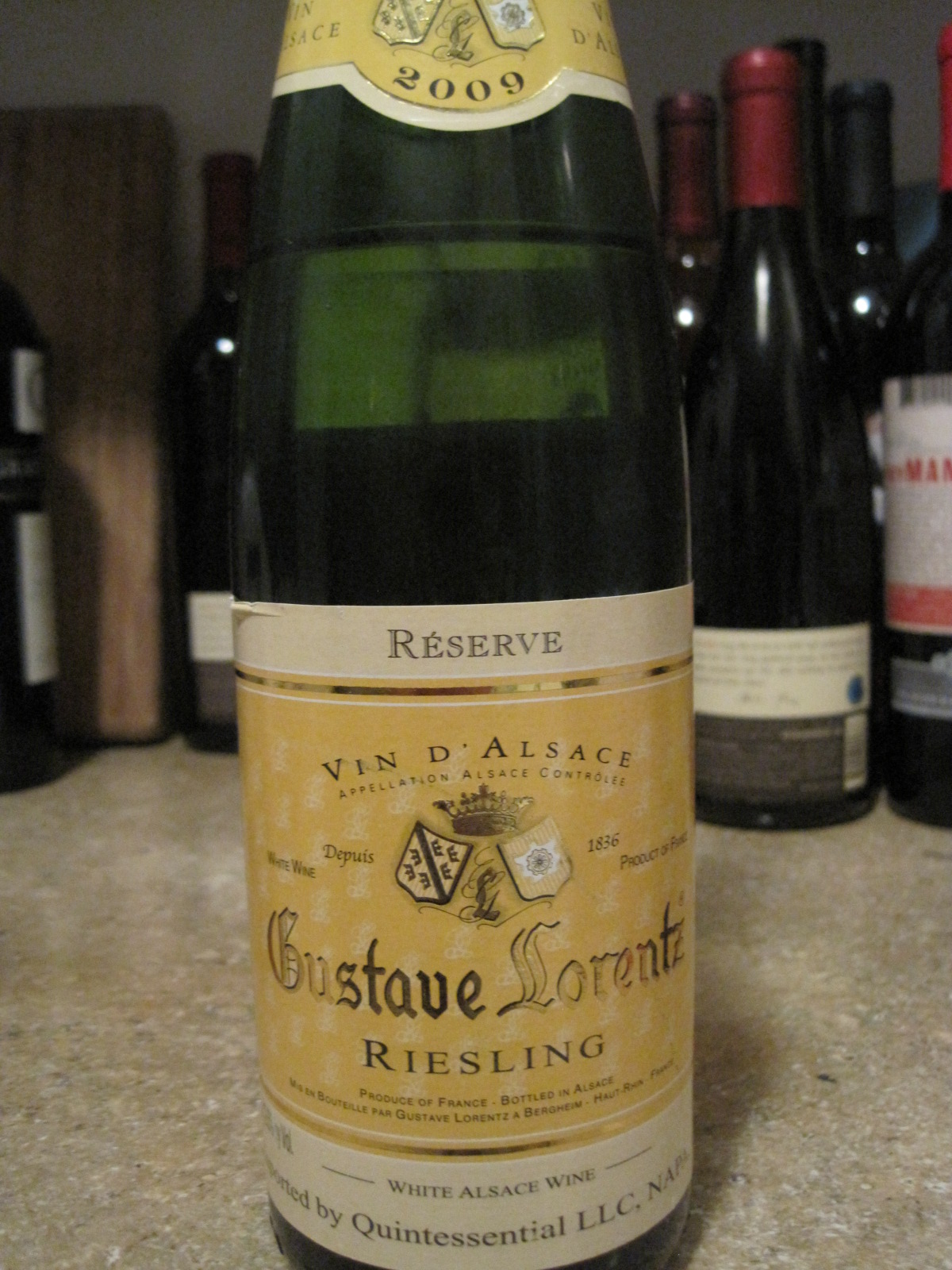
2009 Gustave Lorentz Riesling Alsace (France): Compared to the Austrian riesling I tasted first, this is a different wine entirely. The bouquet is much more expressive, showing aromas of honey, white flower, ripe stone fruit, and hints of petrol. I would say that this bouquet is closer to what I expect from a German riesling, it's got some of those familiar notes. The acidity here is much more integrated and less dominating than in the Fritsch, creating a wonderful textural experience. Flavors of nectarine, apricot, grass, and lime all contribute to a wonderful palate experience. A classic pairing would be spicy Thai food or even tempura sushi rolls. $25 srp. 12% abv.


2011 Schloss Schonborn Riesling Rheingau (Germany): As I swirled and sniffed the last riesling of the flight, I felt most "at home", this is the style of riesling I'm most familiar with. The bouquet screams (to me) that it's German, with beautiful notes of slate, lemon zest, honeysuckle, and intriguing white pepper. It tastes simply outstanding, with a perfectly tipped balance between sweet and tart, a tribute to the residual sugar and acidity both. There are some primary flavors of Meyer lemon, white pepper, subtle tropical fruit, and what I imagine a slab of slate would taste like. After you swallow, the finish lasts a good 20 seconds before gently fading away. I'd love to pair this with deep-fried foods, Thai cuisine, or anything with some heat to it. $54 srp. 11% abv.


These three rieslings were excellent, and worth every penny. While $54 or even $25 is a lot to spend on a bottle of wine you may be unfamiliar with, that $18 Fritsch bottle is well worth a little splurge. One sip and any notions you have of a sweet, syrupy concoction will be obliterated in a rush of fresh, clean fruit flavors and vibrant acidity. I'd recommend it (or any Austrian riesling) to people just starting to explore the grape, but who do love crisp, aromatic white wines already.

For more information on the recent #winechat with the Summer of Riesling, here's a good blog from the Austrian Wine USA's Constance Chamberlain. You can tweet with Summer of Riesling @SummerRiesling, or for more detailed information about specific regions, tweet at @AustrianWineUSA or @drinkAlsace.

The wines in this article were kindly provided as media samples.

Beau Carufel

Thursday, February 23, 2012

#WineChat, Hosted by @Beckyboo503 and @UCBeau, February 29!


That's right, Oregon's premiere wine power couple* will be hosting a #WineChat next week, on February 29th! Since we live in the Pacific Northwest, our focus will be on obscure and under-appreciated wines from these parts. We urge you to do the same and support small producers in the region.

Everyone knows that Oregon makes great pinot noir and Washington's red blends are among the best in the United States. Big deal! What about zinfandel from the Columbia Gorge or dolcetto from Washington? Bet you've never tried those before! Have you ever had a wine made from Marechal Foch? This #Winechat is all about stepping beyond your comfort zone and having fun!

We're awash in an ocean of pinot gris, most of it about as interesting as Coors Light. There's chardonnay and riesling in these parts, but big deal, those are grown all over the country. How about trying siegerrebe from the Puget Sound or gruner veltliner from the Willamette Valley?

The idea here is that trying more wines will make you a better wine taster. Rules don't exist, so feel free to bring whatever you desire to the virtual table. Becky and myself will be sipping some wines from Whidbey Island Winery, ones we ordered just for this awesome event.

2009 Whidbey Island Winery Siegerrebe
2009 Whidbey Island Winery Madeleine Angevine
NV Whidbey Island Winery Island White

So then, you might ask how to participate, and the answer is simple. #WineChat works via Twitter, and we recommend using a free program like Tweetdeck or Hootsuite to follow along. Participants will be using the hashtag "#winechat" during the roughly one hour long virtual tasting. As with every #WineChat, the event is open to any and all who want to have fun and talk about what's in their glass.

We hope to see you there! For more information on what #WineChat is, visit Marie Payton's website The Life of Vines and click the #WineChat page. Cheers!

*the term "wine power couple" is used loosely but is 100% accurate, we are in fact bundles of pure awesomeness. Just sayin'

Beau Carufel