Showing posts with label 2008. Show all posts

Saturday, June 14, 2014

Trione Winery Selections


Yet more wines I was sent a long time ago and am finally now getting around to reviewing. This review will be interesting though, because the Trione Vineyards wines I was sent all came in 50ml bottles. The company tastingroom.com bottled them way back in September 2012 and I am just now getting to taste each one. In total, I was sent six 50ml bottles, each of which is barely good enough for two pours.

Trione is another California winery with an excellent reputation. Their wines were a familiar sight in San Diego and I liked selling them because you always knew that they'd deliver at their price points. It's been nearly a decade though, so I was anxious to taste through the lineup and see if the wines were as I recalled.

As you read through the notes, please bear in mind that these are probably (hopefully) not the current releases from Trione, it's my fault for not getting to them sooner.

2010 Trione Sauvignon Blanc Russian River Valley
The nose shows tart gooseberry and green grass right away, very fresh. Behind that lurk some lime juice and herbaceous qualities. As it opened in my glass, I picked up a flinty minerality that was quite cool. On the palate I can tell that this is softened a little bit by age but it's still got ripping acidity and a linear minerality that I thoroughly enjoy. The fruit seems to be mostly in the background, with touches of grapefruit and papaya showing through. More bracing acidity cleans up the finish beautifully, readying your palate for the next bite. Surprisingly fresh and vibrant, this stuff is almost Muscadet-like. Color me impressed. 14.0% abv. Recommended.

2008 Trione Chardonnay Russian River Valley
It's rare that I get to taste California chardonnay with this much age on it. This one stays traditional, with lots of butter and oak rushing out of the glass. They aren't necessarily overpowering as much as dominating. With some air, I picked up aromas of golden apple, quince, and baking spices. A sip brought plenty of buttercream but a nice hit of acid too. There's enough apple and pear playing around with the vanilla oak and butter to make a really, really nice chardonnay. Acidity dries out the finish in a good way, making me think this needs some grilled sea bass or chicken kabobs. 14.3% abv.

2008 Trione Pinot Noir Russian River Valley
Again, it's rare to taste a RRV pinot with 6+ years of age, so I was looking forward to this one. Initially it's showing age, with notes of dried leather, furniture varnish, red cherry, and old wood. Still, it doesn't smell bad! There's still some acidity on the palate, barely holding together cherries, apple skin, baking spice and white pepper. Still-alive tannin is nicely integrated and I think this would pair well with more delicate meat, salmon and pork. It's not quite my cup of tea but still a really fun wine to taste. 14.2% abv.

2007 Trione Red Wine Alexander Valley
Shows a touch advanced, like it's just settling into some tertiary flavors. Similar to the pinot noir, this has a dusty, leathery element that is pretty interesting. Green herb, cassis, and cocoa powder come through with some swirling. Plenty of barrel spices too, maybe more than necessary. Sipping brings ample black fruit, good acid, and good tannin integration. Mostly cabernet, with merlot, petit verdot, and malbec thrown in. This looks, smells, and acts like a Bordeaux blend that's impeccably crafted. The balance between those advanced aromas and flavors versus the fresher blueberry, boysenberry, and red currant is excellent. If you see a 750ml of this, grab it. 14.5% abv. Highly Recommended.

2007 Trione Cabernet Sauvignon Alexander Valley
Fresher than the red blend, this is still showing plenty of primary fruit. Loads of sweet black cherry and blackcurrant framed by what smells like both French and American oak. That freshness carries over onto the palate too, with more cherries, firm tannin, and plenty of oak. Unfortunately it also gets really hot and sloppy, with perceptible alcohol through the mid-palate and finish. I don't think this is nearly as good as the above red blend. 14.5% abv.

2008 Trione Syrah Russian River Valley
This remained tight despite being open for almost two hours and getting vigorously swirled in my glass. I did manage to tease out notes of black tea, plum, and blackberry preserve. There's a bit of VA present too, which I found distracting. Also, like the cabernet, some alcoholic heat on the nose. On the palate this tastes young-ish, like a wine that is nearly in middle age. That and like it has a bit of brettanomyces. I picked up a distinct medicinal component on the mid-palate and the finish was hollow on the tongue, a big time indicator for brett. Behind the bretty, medicinal note lurked some firm tannins, dusty minerality, and muted fruit. Kind of a bummer because I was really looking forward to tasting this wine. 14.8% abv.

With these wines we batted .500, the sauvignon blanc, chardonnay, and red blend all being worthy of consideration. The other three, pinot noir, cabernet sauvignon, and syrah, had issues which I just can't overlook. Still, Trione clearly makes some very, very good wines and you should feel confident in purchasing (full size!) bottles of the wines I liked. Each promises to be good with food and have the ability to put on a bit of age to boot. I was pleased to find that I still enjoyed Trione after almost a decade of not tasting any of their releases.

The kit from tastingroom.com is really, really cool and gave me just enough wine to do a reasonably proper evaluation. They even include helpful information on how soon to drink the wines and how long they'll (most likely) remain fresh. I think more wineries that send out samples to bloggers might want to look into either this or bottle 375ml's for us, since it wastes far less wine.

These wines were samples for review purposes.

Beau Carufel

Monday, June 10, 2013

Selected Chianti Classico Wines

Chianti wines suffer from an image problem here in the United States. The consumer perception of low quality, fueled by an ocean of cheap Chianti in reed-wrapped bottles has hurt sales. Within Chianti the need was recognized to educate consumers in order to change their perception. Millions of bottles of the cheap stuff still make it here, but there's another side to the region, a more serious side. *cue serious music*


Without getting too deep into Italian wine law, it's important to note that there exist several regions within Chianti, and the one we are discussing here, Chianti Classico, is one of the most significant. Within Chianti Classico lie the historical boundaries of the region, as originally laid out in the mid 1800's.

Right now, there are several grape varieties allowed in the production of Chianti (and Classico) wines. Sangiovese is the dominant, as you probably already knew. In fact, it only recently became legal to produce a Chianti with 100% Sangiovese. Since 1996, the blend for Chianti and Chianti Classico has been 75-100% Sangiovese, up to 10% Canaiolo, and up to 20% of any other approved red grape variety such as Cabernet Sauvignon, Merlot, or Syrah. White grapes are currently banned for use in Chianti wines.

Touching on the aging and alcohol regulations for a moment, Chianti Classico must have a minimum alcohol level of at least 12% with a minimum of 7 months aging in oak, while Chianti Classico's labeled Riserva must be aged at least 27 months at the winery, with a minimum alcohol level of at least 12.5%.

Ironically the quality control issue reared its head with regard to the samples of Chianti Classico I received. Out of maybe 9 bottles, two were badly corked, two had serious Brettanomyces contamination, and one smelled of nail polish remover. Those of course did not get reviewed, but it's clear still more work is needed in the cellars.

2008 Volpaia "Coltassala" Chianti Classico: Warm oak tones dominate the nose at first, overshadowing more subtle aromas of red fruit, herbs, and red earth. On the palate, medium acid and soft tannin work nicely with tart red cherry and plum skin, dried herb, and a finish of smokey game meat. The acidity really shows through on the finish too, where it creates a nice drying effect, readying the palate for another bite of food. *Highly Recommended* 13.5% abv. $50.


2008 Riserva di Fizzano Chianti Classico Riserva: The nose has a lot less oak than the preceding wine, but replaces that with a dominant confection/cherry and dry leather thing. Some VA is present too, but it's not distracting and adds a rustic air to the palette of aromas. Flavors of red soil, tart cranberry, dried herbs and spices, and oak barrel all meld together to create a pleasingly complex, dry Chianti. This has a lot of structure and is just a baby, but has also some great potential. 14.5% abv. $30. *Recommended*


2010 Felsina "Berardenga" Chianti Classico: Oak and soft black cherry notes jumped out at me right away. I also picked up red Jolly Rancher and pepper notes. This, just by the smell, seemed like a very young wine. It's dry and soft on the palate, with plenty of tannin that partially obscures tart red fruit, peppery spice, cinnamon, and soil flavors. I suspect this is a wine to either decant now or just wait a few years on. Great acidity should hold everything together for several more years. 13.5% abv. $18.


2008 La Porta di Vertine Chianti Classico Riserva: Shows some brett in the form of smoked meat and band-aid, also some dark fruit - think black cherry and plum. Out of the four I opened, this had the most black fruit compared to the redder orientation of the previous wines. It's also got some considerable oak influence from the mocha notes I picked out too. Nice drying tannin but a curious lack of acidity left me somewhat confused. There isn't much on the palate beyond bitter grape stem and more mocha notes. Somewhat disappointing. 14.5% abv. $50.


The above wines are not cheap, save for the Felsina, which is very reasonably priced for the quality. The more I thought about these wines, the more I concluded that they are not QPR winners by any means, but that a couple of them were quite good and the 2008 Volpaia was excellent. Still, as a wine lover and someone who spends a significant portion of his income on wine, I still cannot say I would buy Chianti Classico over a Brunello di Montalcino or Barbaresco. On the other hand, if you are smitten with Italian wines, these could be very reasonable prices to get wines which are, according to the law, higher in quality.

These wines were media samples.

Beau Carufel

Friday, January 18, 2013

Hawk and Horse Vineyards, a Lake County Producer

Every so often I'm sent samples that truly pique my curiosity  No grocery-store red blends or cheap California plonk, but real, small production wines from tiny producers in up and coming regions. Hawk and Horse Vineyards is one of those, hailing from the Red Hills AVA of Lake County. Currently there are 18 acres under vine with the majority being cabernet sauvignon planted in 2001. The property is situated on the rolling slopes of Lake County, at elevations ranging from 1,800 to 2,200 feet.

Hawk and Horse Vineyards has been Demeter Certified since 2008 and California Certified Organic (CCOF) since 2004. Both new and used French Oak barrels are used, and production hovers around 1,150 cases of cabernet sauvignon.

Confession: I was sent the 2007 Cabernet and 2006 Latigo a long time ago, but they became lost in the samples shuffle and move to Oregon. I dug them out for our July 4th celebrations (last year), figuring that the cabernet would pair well with Becky's ribs and the dessert wine would be a pleasing accompaniment to the fireworks. The cabernet did pair quite well with Becky's ribs, by the way.

Some months later, I was sent the 2008 Cabernet to taste, and decided to post up a review of all three wines at once, in order to better offer a view of this producer.

2007 Hawk and Horse Cabernet Sauvignon Red Hills: Smelling this makes me picture dry, hilly vineyards full of green-leafed vines stretching to the horizon. The day is cool but carries with it the scent of the land. Moutain herbs, black fruit, and soil all show themselves almost reluctantly on the bouquet. Unfortunately there's a touch of ethyl acetate at play too, manifesting as nail-polish. Once past that, I found this to be wound up very tightly on the palate. The firm, integrated tannin holds within it a beautiful savory blackberry and spice flavor. Roasted coffee mixes with cassis and dried rosemary in the background, bowing before the impressive tannic strength. I think this cabernet has 5-10 years before the tannin settles down. If you choose to drink now, a healthy session in a decanter will loosen the strings. SRP: $65. 14.1% abv.


2006 Hawk and Horse Latigo: This is the dessert wine - made with cabernet sauvignon grapes - that Hawk and Horse produces. According to the label, these are biodynamically farmed organic grapes. I'm not sure what that means though. The Latigo smells like oxidized cabernet sauvignon. Maybe a comparison would be Madeira from an old bottle you've had open for a few months. Don't let that turn you off though, because taken in context, this is an interesting wine. Roasted nuts, dried red cherry, and dark chocolate make up the expressive bouquet. I liked the intense mix of cherry, spices, and chocolate that compose the flavor palette. It's at once sweet yet balanced, and doesn't show any of the 16% alcohol. If you can get past the nose, you'll be doing just fine, and I suggest pairing this with an after-dinner cheese course. $45 srp (375ml).


2008 Hawk and Horse Cabernet Sauvignon Red Hills: Another big, tannic beast of a cabernet sauvignon. That's not a bad thing though, as this wine has a lot to offer if you give it time to settle. Plenty of dark fruit, dusty soil, baking chocolate, and oak make up the complex bouquet. The tannin is firm and drying across the palate, delivering a wave of bittersweet chocolate, dried herb, and ripe black fruit flavors. The most glaring fault was how hollow this wine felt on the mid-palate, but luckily that fills in when you have it with food. If you must drink now, several hours in a decanter will work wonders, as will a thick, medium rare cut of steak. $65 srp. 14.1% abv.


Hawk & Horse Vineyards produce a cabernet that I think you should try, if solely to understand what kind of cabernet is possible outside of Napa Valley. Then again, trying a wine solely for that reason strikes me as missing the point, especially the point of wines like this. They're wines of the land, baring their souls as rugged, strong wines from a distinctly rugged place.

The impressive structure and sheer age-worthiness of these wines excite me. They're a bit rustic around the edges to be sure, and I think could benefit from maybe a bit more intervention in the wine-making process, but there is also a sense of beauty to each wine. Both the 2007 and 2008 beg for more time in bottle, and if you grant them such time, you'll be rewarded.

Even the Latigo, that strange beast of a dessert wine, offers a peek into the Hawkins' philosophy of life and vitality. I can't help but be impressed with this.

These wines were samples for review purposes.

Beau Carufel

Friday, August 17, 2012

Summer Barbecue Wine Options

Summer is in full swing! It's time to barbecue as much as possible, to have your friends over at every opportunity, and to enjoy the sun whenever you can. To that end, I've lined up a slew of affordable reds and whites for you to pair with barbecued foods and backyard shindigs.

Keep in mind that these are all bigger, more full-bodied red wines Anytime you have big flavors from meat, you need to get big wines to stand up to what you're grilling. The addition of sauces, marinades, and rubs also adds intensity, further pushing palates away from pinot-land.

The white wines, on the other hand, are crisp, dry, and full of refreshing acidity. On a hot day the last thing most of us want is a big, heavy, oaky chardonnay weighing down our taste buds. To that end, I assembled a panel of well known producers' white wines to taste and talk about.

Here then are two lists, of whites and reds, for your consideration as you barbecue this summer:

White:
2010 Parducci Small Lot Blend Sauvignon Blanc: Despite the $11 suggested retail price, this is single vineyard sauvignon blanc, from Hildreth Farm in Mendocino County. Crisp notes of green apple, grass, and zesty citrus mix with summer melon to create a balanced, food-friendly wine. Very drinkable and at a great price. Pair this with ceviche, fish tacos, chicken salad, or solo on a hot day.

2010 Parducci Small Lot Blend Pinot Gris: I think it's telling that I tasted this and thought it might be a steel-tank-fermented, un-wooded, cheap chardonnay. 6% Muscat Canelli was added to the gris, creating an intersting, barely-off-dry citrus and melon set of flavors. If sauvignon blanc or 100% pinot gris is too dry for your friends, I bet they'd love this. Very pretty aromatics, so don't over chill it. $11 srp.


2011 St. Supery Sauvignon Blanc Napa Valley: Loads of tropical fruit beats down a touch of green grass that dares show itself. I like that though. Crisp acidity frames the melange of passion fruit, kiwi, and lime flavors. There is a subtle but welcome minerality at play, enhancing the texture. Pair this gem with grilled-shrimp quesadillas and fresh guacamole. $15 srp.


Red:

2009 Parducci Small Lot Blend Merlot: The bouquet is all red cherry and licorice, with a bit of a medicinal quality. On the palate it's spicy, cherry, and vanilla oak. This brings the easy-drinking flavors you expect from an inexpensive merlot. Give this one to your "I don't like red wine" crowd. SRP: $11. 13.5% abv.


2010 Hey Mambo "Sultry Red" Red Wine: An explosion of red fruit; think cherries and raspberries mixed together. It's sweet and easy-drinking, with ample ripe fruit flavors and a tease of vanilla-oak lurking in the background. The finish is just dry enough to stand up to bigger foods. Another "I don't like red wine" crowd pleaser. SRP: $10. 13.5% abv.


2010 Graffigna Centenario Malbec Reserve: This bouquet is all dark aromas, think baking chocolate, spices, and leather. Some black cherry and blueberry peek out too. More full-bodied than the previous two wines, the Graffigna has ample tannin to stand up to steak. Flavors of black fruit, herb, and bittersweet chocolate create a nice texture on the palate. Worth opening a few hours before your party. SRP: $15. 14% abv.


2008 Ash Hollow Headless Red: This one is intriguing, it smells a little reductive but revels aromas of maple and bacon, black fruit, and wood. 58% merlot, 26% cabernet sauvignon, 13% syrah, 3% malbec. There maybe some volatile acidity here too, but it's not a big deal. More maple flavor comes through on the palate, along with spices and black cherry. This one is smooth and easy to sip, while retaining enough tannin and acid to stand firm against a steak or summer sausage. 30 months spent in oak. 14.1% abv.


2009 Parducci Small Lot Blend Cabernet Sauvignon: When I first opened this bottle, I was walloped over the head with a bag of oak. The wine has settled down a lot, with the oak partially retreating and letting some warm red fruits, earthy funk, and green herb come out. Firm tannin restrain that red fruit on the palate, creating a simple yet effectively structured wine to pair with steak or ribs. It's more complex than expected, especially at the $11 price point. 14.0% abv.


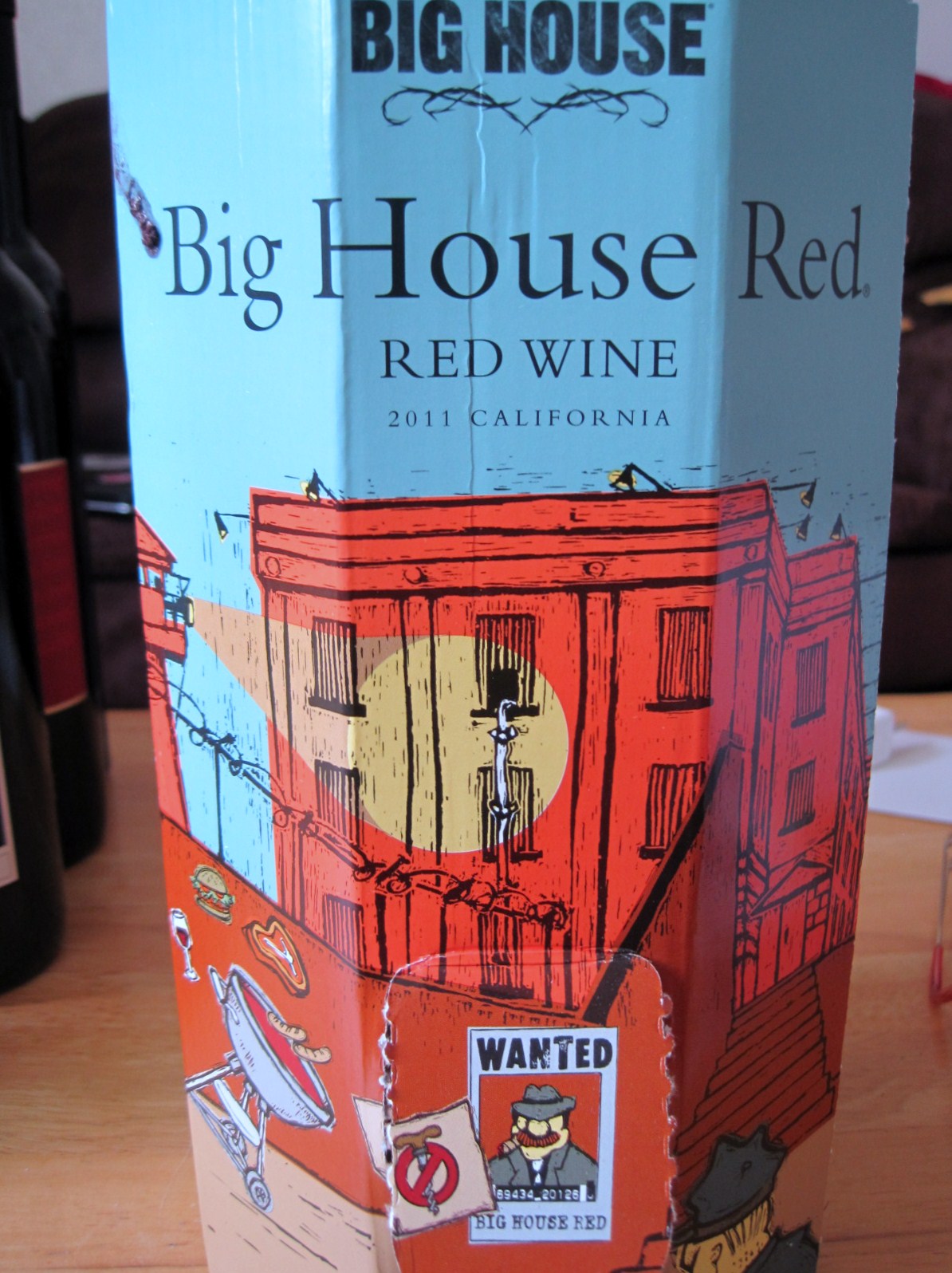
2011 Big House Red: The fact that this wine has over 15 different grape varieties should tell you something. My sample showed up in a 3L cask or bag-in-box, in an effort to prove that quality isn't lost. 3L is about four bottles, making this a $5.50 per-bottle red wine. The nose is an explosion of fruity aromas, think raspberry jam, strawberries, blackberries. It's no different on the palate, with jammy fruit leading the way, thankfully reined in by a bit of acidity. It'll go great during the summer when you're headed to a bbq party, and fits the very definition of "crowd pleaser". 13.0% abv.


2009 Ravenswood Sonoma County Old Vine Zinfandel: Joel Peterson consistently produces great wines at reasonable prices. This zinfandel, coming in around $15 a bottle, has all the hallmarks of old vines from warm climates. Aromas of wood smoke, tar, plum, and spices rush out of the glass. I like the complexity, especially at this price point. Lots of dark, intense red fruit to pair with ribs too, along with a wonderful peppery flavor that contrasts with some dark, dusty soil. A tight, clean package of deliciousness. 14.5% abv.


2009 Ravenswood Vintners Blend Petite Sirah: Imagine a bowl full of blueberries and blackberries sitting in a field of dark, earthy soil. Now imagine someone burning oak just a few hundred yards away. That's the nose of this petite sirah. It tastes spicy and rich, with lots of black fruit, dark chocolate, and firm tannin to restrain those two primary flavors. Practically begs for a thick steak, and is a really good deal at $7.99. 13.5% abv.


To test the wines out in more real-life conditions, I had them all open for a barbecue that several of our friends attended. Each wine was tasted along with the food, which included ribs and hot dogs, among other things. My personal favorites were the Ravenswood wines, and the Graffigna Malbec. The group did enjoy the Big House Red and Hey Mambo for what they were, big, fruity, easy-drinking reds.

Each of these wines is worth a pop 'n pour when you are grilling and want something to please a wide range of palates. Perhaps the best part is the pricing, all can be found for between $10 and $15, save for the Big House, but you get a lot of wine in that octagon!

These wines were media samples.

Beau Carufel

Sunday, August 12, 2012

Wine Industry Technology Symposium Live Tasting With @WineTwits

During this year's Wine Industry Technology Symposium, a group of wine bloggers were sent four wines from California and invited to participate in a live, virtual wine tasting. Frequent readers (all four of you) might be familiar with this format, as I've posted recaps of these tastings fairly often over the past few years.

The way a "virtual tasting" works is by having bloggers around the country receive the same wines, then use Twitter and a specific hashtag to talk about each wine. Usually there's a moderator, in this case the fine folks behind the @WineTwits account and website. We talked (tweeted) about each wine over the course of about an hour, with the various participating wineries chiming in to answer questions and give data points.

I tend to enjoy some aspects of virtual tastings, especially when bloggers whose palates I trust are participating. We get to compare notes and really dive into what the wines are about. The other side of virtual tastings is that all too often we get bloggers who do nothing but tweet hyperbolic statements praising every wine. Not only do they look like idiots, it undermines our already-fragile credibility as a group.

Each wine selected has the benefit of being easy to find in grocery stores and BevMo-type outlets, being of high enough production to virtually guarantee nationwide distribution. The sole unfamiliar wine to me was the 2010 Garnet Vineyards Pinot Noir, the rest have all graced my wine glass at some point in the past few years.

2010 Wente Morning Fog Chardonnay Livermore Valley: The bouquet is full of lemon cream, tropical fruit, and popcorn butter aromas. To me it smells exactly like I'd expect a traditional California-style chardonnay to smell like. On the palate there's a nice bit of that tropical fruit, some more lemon notes, vanilla, and more of the buttery taste. The acidity is low, or at least, feels low due in part to the malolactic fermentation that this wine saw. Wente consistently makes drinkable wines, and if you're a fan of buttery California chardonnay, I think you'll really enjoy the Morning Fog bottling. 13.5% abv. $11 retail.


2011 Hahn Winery Nicky Hahn Pinot Noir California: Pours a beautifully vibrant ruby color in the glass, a testament to its youth. The nose is full of ripe, jammy cherry preserves, baking spice, some woodsy aromas, and a touch of earth. Cherry jam dominates the palate, providing a soft, rich mouthfeel. The baking spices come out to play a little bit on the finish, which in itself is nice if a bit short. 100% pinot noir, according to the data sheet I have. 14.5% abv. $14 retail.


2010 Garnet Vineyards Pinot Noir Carneros: Loads of raspberry and strawberry aromas followed by a bit of white pepper spices. I think there's a bit of funk here too, some nail-polish remover came out as the wine warmed up. I think this pinot is very varietally correct on the palate, with light red fruit, peppery spice, hints of earthy funk, and lots of acidity. The finish is medium length, tapering off nicely, however, the bottle was open about five hours before the finish got to be any reasonable length. It might need a bit of age or an hour in a decanter before it shows all its facets. 13.5% abv. $19 retail.


2008 Franciscan Magnificat Napa Valley: A blend of 69% cabernet sauvignon, 23% merlot, 6% petite verdot, and 2% malbec. This Meritage pours dark, almost opaque garnet. Pepper, wood smoke, cassis, and leather rush up out of the glass. There's a touch of alcoholic heat, nothing more. Lots of ripe black fruit mixed with oak form the primary flavors. Secondary flavors include smoked meat, cocoa dust, and dried spice leaves. A nice long finish shows earth and leather before disappearing in a burst of dried black cherry. This is a 2008, and it shows true to form as a very young wine. Lots of firm tannin that will soften and integrate with age. I tasted this again after six hour and it had mellowed out noticeably. 14.5% abv. $35 retail.


The wines we tasted were all interesting and well made. The Franciscan was very good, and the clear leader of the group. I re-tasted each wine about six hours after I opened them and save for the Meritage, they'd all begun to fall apart. Out of the latter three, the Wente chardonnay held together best, still retaining some acidity and complexity.

The WineTwits crew did a great job getting such a large group of bloggers together and keeping the discussion moving along, but weren't as active with the technical facts and winery-liaison work that I've seen from other virtual tasting hosts. Perhaps that will change in the future, should they do another tasting. Then again, it's not always necessary to constantly chime in if the discussion is flowing nicely.

You can find each winery on social media here:
@Wente and on Facebook at: https://www.facebook.com/WenteVineyards
@HahnWines and on Facebook at: https://www.facebook.com/HahnFamilyWines
@FranciscanWines and on Facebook at: https://www.facebook.com/FranciscanEstateWinery
@GarnetVineyards and on Facebook at: https://www.facebook.com/GarnetVineyards

and @WineTwits

Thanks for inviting me!

These wines were media samples.

Beau Carufel

Wednesday, June 27, 2012

Wine Club Review: California Wine Club Sends Tobin James Selections


I was sent the second in a series of three shipments from the California Wine Club recently. The first shipment was wines from Fess Parker, a very well known and respected winery in Central California. This time, another well known (and respected) producer called Tobin James Cellars was selected for us.

2010 Tobin James “Radiance” Monterey County Chardonnay: This chardonnay pours a pale gold in the glass, and you're immediately struck by a mish-mash of buttered popcorn, lemon, and tropical fruit aromas. Sourced from Lockwood Vineyard in Monterey County, only 4,000 cases were produced in 2010. On the palate it's got a lot of acid and no real trace of oak. Indeed, only 8% of the harvest was barrel-fermented. Lots of zesty citrus on the palate combines with some buttery texture to create a bit of an awkward mouthfeel though. The finish is medium-length and gently evaporates from the palate. Overall, a solid if unremarkable chardonnay that will probably please the masses. 13.8% abv. SRP: $18, CA Wine Club: $10.99


2008 Tobin James Titan Hills Vineyards “Fiasco”: This is something interesting, a wine made from grapes harvested over a 1.5 month period, from 20 vineyards. When I read the info sheet I scratched my head, but figured what's the worst that could happen? Mostly syrah (55%), with 25% zinfandel and 20% barbera thrown in to complete the blend. Alcohol is a rather large 14.9%, according to the label. I wouldn't be surprised if it was closer to 16% though. Loads of peppery spice, jammy black fruit, and wood smoke rush up out of the glass. Oh and alcohol too. The palate shows big, jammy black fruit, more wood smoke flavors, earth, and black pepper. Bring this one out during your barbecues and watch your non-wine-geek buddies lose their shit. SRP $21, CA Wine Club: $11.99.


As with the previous California Wine Club wines, this shipment was 1 for 2. The chardonnay wasn't that great, and to me it tasted like it cost $10 at a grocery store. On the other hand, I know a bunch of people who I'd love to have over to share the bottle of "Fiasco" with, while we grill up some thick steaks and burgers. If I paid $21 at a retail store I'd be ok with that, but I love the California Wine Club price of $11.99.

One final thought before I wrap this up; as I browsed the literature, I noticed both wines were released a while ago. In the case of the Radiance chardonnay, a year ago. The "Fiasco" was released way back in the summer of 2010. I would imagine that the 2011 Radiance chardonnay is about ready to be released, and the Fiasco too - if they've made another batch. That might explain why these are available at such a discount, the California Wine Club could have gotten them on a closeout, at lower prices.

You can find the California Wine Club on Twitter as @cawineclub and The Boring Wine Guy as @boringwineguy. Bruce Boring is one half of the founding team behind this club, the other being his wife Pam. The California Wine Club Facebook Page is also full of activity and a good place to talk about your experiences. The Boring Wine Guy is also on Facebook. If you use the code "beau12" at checkout, you will get four bottles instead of two. That might be the best deal of the whole club!

These wines were provided as media samples in collaboration with Mom Spark Media.

Beau Carufel

Sunday, May 20, 2012

Summer Syrah Sipping Suggestions


(img src: http://www.nysun.com)
I love syrah. As such, whenever I get a lineup of syrah to taste, my excitement level ramps up. The grape is criminally underappreciated here in the United States, perhaps as a result of [yellow tail] being foisted on naive palates. That under-appreciation helps to keep prices down (for the most part) on domestic syrah, which pleases me to no end. Considering how overpriced cabernet sauvignon and pinot noir are, finding refuge in syrah's intoxicating mix of ripe black fruit, dried herb, heady spices, and smooth tannin brings many a wine geek moments of sheer joy. There was even an "Occupy Syrah" day last year, which I wrote about while tasting some delicious wines.

Here then are some domestic syrahs I was sent to sample. All are from California, and all were tasted blind first, then unmasked and re-tasted over the course of another day.

2009 Mandolin Syrah Central Coast: Aromas of wood, burnt match, ripe cherries, plums, and a sensation of alcoholic heat. As in the previous bottle of this I tried, I suspect there's a sulfides issue present. On the palate this syrah is somewhat thin and astringent, with none of the ripe, deep fruit character that I would expect. Rather, there's a simplistic red fruit that evaporates quickly. The acidity is nice but the overall impression I get is that of a hollow shell, or put more bluntly, a cheap wine. Disappointing, because the Central Coast of California can produce amazing syrah. 14.6% abv. $11 srp.


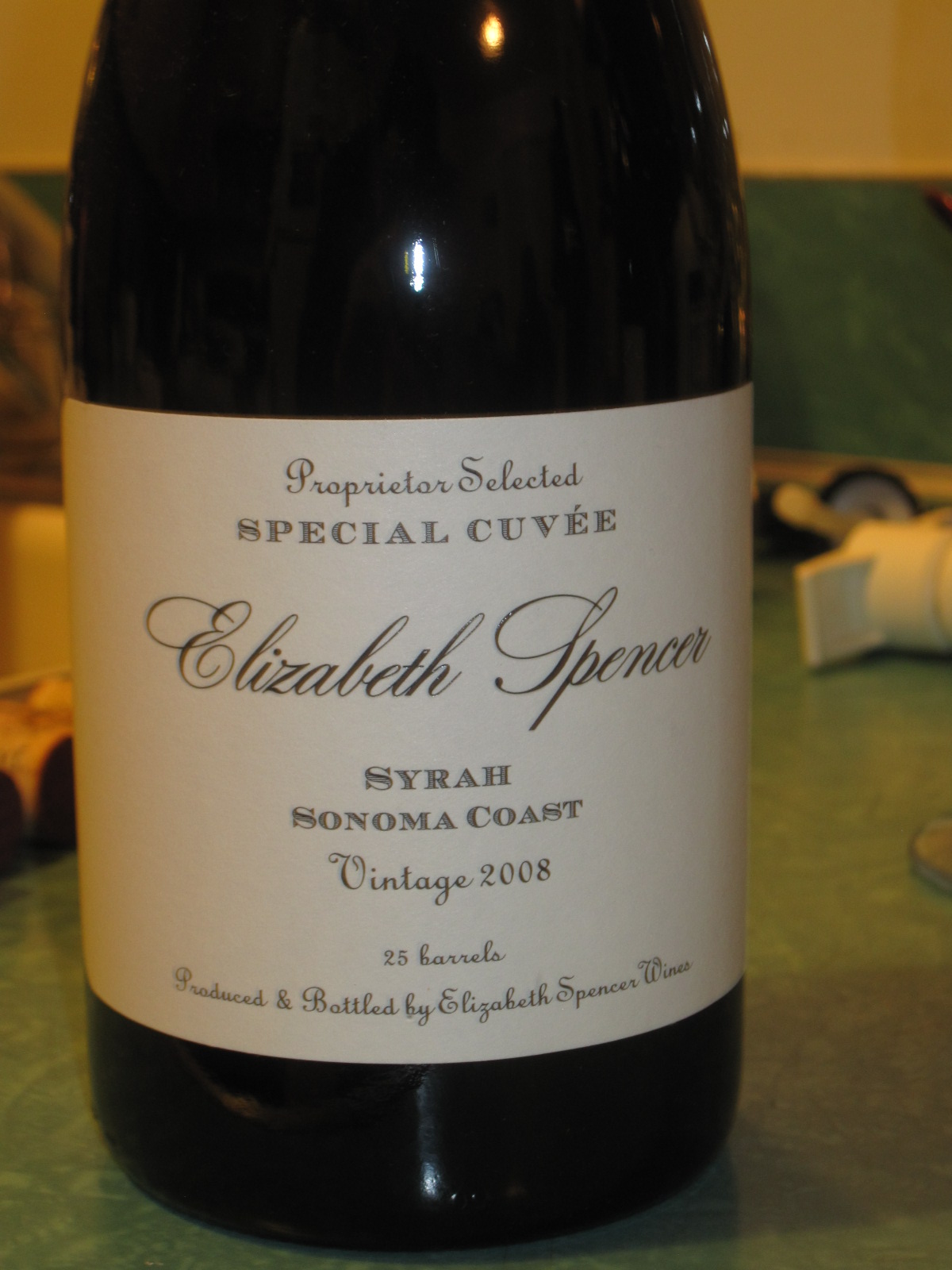
2008 Elizabeth Spencer Syrah "Special Cuvee" Sonoma Coast: A complex nose of fresh black fruit, molasses, baking spices, dried herbs, and wood are unfortunately held back by a subtle alcoholic burn. Still, I'd be lying if I denied that this syrah smells incredibly good. On the palate it's rich and mouth-coating, revealing flavors of blackberry, peppercorn, tar, and mocha. Chewy tannin give a wonderful structure to balance out the ripeness. The whole packages is closed out with an impressively long finish of herbs and dusty soil notes. I must say though, that I don't believe for one minute that this is truly 14.9% alcohol, I'd bet it's closer to 16.0%. $35 srp.


2006 James David Cellars Syrah Central Coast: Pours a very dark garnet, almost purple, in the glass. Aromas of Almond Joy candy, pencil lead, blackberry preserve, and fresh cut lumber. Definitely oaky, and there may be a an ethyl acetate issue forming due to the nail-polish remover burn. The palate is thin and drying, without much character other than alcoholic burn and grainy wood. With a listed alcohol of 15.7%, I suspect that could be a lot higher. I did notice the tannin, and if this wine had any lush, clean fruit flavors to show, that tannic structure would do a beautiful job creating balance. $N/A.


2005 James David Cellars Syrah Eaglepoint Ranch Mendocino: Pouring a much "redder" ruby into my glass, my first impressions of the bouquet were of garrigue and cherry preserves. There's a pleasant earthiness along with some nice mocha notes and a dollop of wood. There's some alcoholic heat too, but it isn't distracting. This style, for my palate, is what I love about California syrah. Balanced fruit, earth, and oak elements all play nicely together. There's some firm tannin at play, acting to nudge each element back into balance as they struggle to break out of the tannic pen. Red cherry and raspberry, herbs, and a dusty minerality compose a syrah I'd love to pair with a steak, or ribs. This 2006 is wearing its age with grace and class, as well as looking to improve with a few more years in bottle. 15.5% abv. $N/A.


Maybe the title of this post should be "The Good, The Bad, & The Ugly". On the one hand, the Mandolin was disappointing to me, again, despite it's generally good reviews from Steve Heimoff and Bev-X. I could chalk it up to bottle variation though, especially at such a low price point. The 2006 James David was way too big and alcoholic for me, but if you're into lush, rich syrah you will love this one. On the other hand, the 2005 James David Eaglepoint Ranch was delicious despite the high-ish alcohol, as was the Elizabeth Spencer.

Any of these wines would pair beautifully with grilled meat, pizza, lamb, lasagna, or on their own. Despite being a full-bodied wine, syrah is versatile, and each of these wines does showcase a certain stylistic take on the grape. As we move closer to summer, I hope to offer more syrah reviews so please don't hesitate to recommend examples to me!

These wines were media samples from their respective producers.

Beau Carufel


Sunday, April 8, 2012

Von Holt Wines Should Be On Your Radar

When a former Secret Service agent, having served for over 20 years, retires and starts making wine, people are going to notice. Having a unique story helps creates authenticity, which in turn helps garner respect. Of course it goes without saying that the wine (in this case) must also be good. Von Holt Wines, started by Chris Von Holt and Pamela Miller, is garnering respect, due in part to their authentic wines.


Von Holt Wines is a new player in San Francisco's urban winery scene. Chris sources grapes from the coolest regions of the Russian River Valley and Sonoma Coast with the goal of creating wines that are textured, compelling, and authentic. Sure, that sounds like old hat, every producer makes those claims, but not nearly as many follow through. I got the chance to see if the Von Holt lineup was truly living up to it's claims, and after the fold I'll explain my findings.

I was sent three bottles of the current Von Holt releases, a couple of 2008 syrahs from Hoppe-Kelly Vineyard and Old Lakeville Vineyards, respectively, as well as the 2009 Suacci Vineyard Pinot Noir. Hoppe-Kelly is located in the Russian River Valley and Old Lakeville is in the enormous Sonoma Coast appellations. Suacci Vineyard is also in the Sonoma Coast AVA. I should also note that those are the first ever releases from the Von Holt label.

To emphasize how small Von Holt Wines' production is, here are the numbers; in 2008, the Hoppe-Kelly syrah was at 75 cases, as was the 2008 Old Lakeville. The Suacci pinot noir was producer in greater numbers, all of 225 cases. Not a lot of wine, to say the least.

2009 Von Holt Suacci Vineyard Pinot Noir: From the much-heralded 2009 vintage, this pours a beautiful ruby color that lightens towards the edges of the glass. It's got a mouthwatering bouquet of strawberry Jolly Rancher, earth, baking spice, and black tea. I noticed that the more this pinot sat in my glass, the better it smelled. On the palate, the Von Holt impresses with it's balanced flavors of red fruit and earth. There is ample acidity, creating a beautiful structure that should support the wine over the next ten years. Perhaps one of the most enjoyable pinot noirs you can buy right now. 13.3% abv. Price: $42.

2008 Von Holt Hoppe-Kelly Vineyard Syrah: This vintage is often cited as a great one for thicker skinned grapes like syrah, cabernet sauvignon, and zinfandel. I couldn't agree more. This 2008 pours a ruby-garnet, paling towards the edges of the glass. The bouquet is typical cool-climate syrah, with lots of peppery spice and black fruit, tar, and oak that threatens to dominate. That said, the oak will recede with time in the glass and/or more bottle age. On the palate, a well balanced mix of ripe blackberry and blueberry flavors bounce off earth and pepper notes. There's acidity in abundance, helping restrain all that ripe fruit. This is really good California syrah, especially considering the price. 14.2% abv. Price: $20.

2008 Von Holt Old Lakewood Vineyard Syrah: Pours a more consistent dark-garnet in the glass compared to the Hoppe-Kelly Vineyard bottling. Aromas of fresh baked pie, oak, and black peppercorn. The palate is bursting with cherry and blackberries that only get pulled back by that effective cool-climate acidity. A fine-grained tannin is present but never becomes bothersome, rather, it integrates well with the finish, creating a nice tapering effect that I love. When people rag on California syrah, this is what I wish they'd drink. It's a mind-changer, with the balance needed to pair beautifully with food. 14.3% abv. Price: $30


After tasting through the Von Holt wines I was struck by how delicious they were, for one. Also, I noticed that the wines exhibited a sense of balance and completeness. To explain, that means that while the ripe fruit flavors are present, each bottling possess enough acidity to prevent them from developing into fruit bombs. This is especially appreciated in the syrahs, which too often are overripe, sweet concoctions. Each wine had it's own personality, lending further credibility to our question of authenticity.

By sourcing good fruit combined with the skills of winemaker John Fones and adviser Ed Kurtzman, Chris Von Holt and Pamela Miller have created some outstanding examples of cool climate California red wines. Each wine I reviewed gets my highest recommendation, and I urge you to act fast. When last talked to, Chris said that all three of these bottlings were running out quickly. That's not surprising though, given the level of quality.

Oh, and check out those alcohol levels. That, folks, is how you make wine that's both full flavored AND balanced.

Von Holt wines is on Twitter: @VonHoltWines and Facebook: https://www.facebook.com/vonholtwines

These wines were received as media samples.

Happy Easter!

Beau Carufel

Monday, March 19, 2012

Blind Tasting Oregon Pinot Noir, Round Two

After the last post on a blind tasting of Oregon pinot noir I did garnered some attention, I am writing up another blind tasting I did recently. Our friends Lars and Dave hosted Becky, Kim, and me at their beautiful house for a blind tasting of six pinot noirs, five from Oregon plus a ringer bottle I brought. More on that ringer bottle later...

The theme again was Oregon Pinot Noir, but the vintages and regions were up to us. As it happened, every pinot noir was from the Willamette Valley and the vintage spread was 2004-2010. Next time I am going to try to bring an older bottle and see if anyone mistakes it for a Burgundy.

I've been pretty down on 2009 Oregon pinot noir because most examples I've tasted were too ripe, flabby, and high in alcohol for my tastes. 2008 offers better age-ability and the 2007's are drinking fantastically well despite the many critics who gave the vintage a poor score. As an aside, I feel that the issue with the 2007 vintage illustrates another flaw in our continued reliance on supposedly "expert" wine critics who make proclamations which then have a very real impact on the sales of those wines.

Critic-bashing aside, I've been also very keen on 2010 pinot noir, because I love the acidity and more delicate fruit flavors compared to 2009. In the interests of integrity, I did try my best to throw my preconceived notions out the window for this blind tasting. It helped that the wines were in brown paper bags.


Below are the tasting notes for each wine, in order of tasting. I'll include my rankings, subjective as they might be, at the bottom of this post. The notes below are mostly unedited too, in the hopes that you'll see my thought processes as I tasted each wine.


1. 2010 A.F. Nichols Lillie's Vineyard Dundee Hills:
N: Aromas of grape stem, red cherry, and hints of herb and cola. Might be a touch of VA on the nose too, almost medicinal in nature. Smells young, this might be a 2010 or lighter-style 2009.
P: Light but with great acid, more of the grape stem quality. Red cherries and soil come through, very clean tasting. Good finish, a little bit sudden though. Lots of potential, could be great in a few years.

2. 2004 Left Coast Cellars Suzanne's Estate Reserve Willamette Valley:
N: VA? (ed: volatile acidity) Caramel..oak..darker fruit like wild strawberry mixed with black cherry. Some green stemmy qualities too. Could be a 2008, maybe older though? 2004/5?
P: Dried cherry, stemmy notes. Good acidity, really zings. Hints of rhubarb, minerality, and cola. A bit astringent on the finish, also somewhat evaporative. If this is young, it's got potential...if not, drink now..

3. 2009 Antica Terra Willamette Valley:
N: Earth and red fruit, smells young! Vibrant acidity but also some noticeable oak. Baking spices, something like damp forest floor too. Intriguing!
P: Ripe, rich style. 2009? Raspberry and strawberry fruits give it good acidity but it's just a bit too fleshy for my taste. Oak notes come through, not as strongly as on the nose. Easy drinking, good wine.

4. 2008 Vista Hills Tusculum Estate Dundee Hills:
N: Smells bad, like a skunk. Also some meaty, minty aromas. The skunky smell is distracting for me. Puzzling. Has some boozy thing too, an alcoholic burn in my nostrils.
P: Puzzling, there's a nice Oregon funk note, but also something almost Brettanomyces-like. Dark fruit and bramble on the finish. Tastes better than it smells but it's kind of rough going.

5. 2009 Lenne Yamhill-Carlton District:
N: Cherry/Strawberry candy, cherry pie, grape stems. Baking spices and lots of wood! Wowie.
P: Very ripe mouthfeel, interesting acidity, seems to weave in and out of the palate. Cola, cedar, and a peppery finish. Not that bad but it's not that good either. Most interesting aspect is the acidity and it's effect on the palate.

6. 2008 Elizabeth Spencer Special Cuvee Sonoma Coast:
N: Cherry preserves, a touch of alcoholic heat, but a lightness too. Ripe red fruits dominate but behind that is a spicy component which was immensely pleasing.
P: Light red fruits, it's muted compared to the aromas. Lower acid levels than the other wines, it is probably the California wine. Clean, easy drinking, touches of oak around the periphery.

Thanks for making it all the way down here! Here's my list, in order of preference. I've linked to cellartracker.com too so that you can get an idea of what the greater wine drinking community thinks too.

1. 2010 A.F. Nichols
2. 2009 Antica Terra
3. 2004 Left Coast Cellars
4. 2009 Lenne
5. 2008 Vista Hills
6. 2008 Elizabeth Spencer

In terms of rating, I held the Elizabeth Spencer out because it wouldn't be fair, but if I had to rate it, the third spot would be appropriate. Out of all the wines, the Antica Terra surprised me, and while I feel it is overpriced, the quality is undeniable. I'd never had Lenne or Vista Hills wines before, but know them by reputation, and I've heard good things about both producers. Stylistically, they're not what I look for in an Oregon pinot noir and I still struggle to figure out what that skunky smell was in the Vista Hills.

Blind tasting is a great way to find out where your bias lies, as long as you make the effort to toss out preconceived notions. While we don't blind-drink our wines, for educational purposes, blind tasting is perhaps the best way to get acclimated with a region new to you, or even to stay sharp on a region you're familiar with. In addition to all of that, blind tasting with your friends is a blast, as you all finish your own observations, the guessing game becomes a really fun activity. What blind tastings have you done recently?

Beau Carufel

Tuesday, March 13, 2012

Chateau La Nerthe: Tasting the Southern Rhone Valley

In February I had the opportunity to taste the current releases of the Chateau la Nerthe family of wines. This Chateau, dating back over 800 years, produces wine throughout the southern Rhone Valley. Besides the Chateau La Nerthe label, they also produce the Domaine De La Renjarde, Prieure de Montezargues, and La Petite Fontaine wines. As such, La Nerthe is both a producer and negotiant. The portfolio of Chateau La Nerthe is imported by Pasternak Wine Imports of New York.

The tasting, held at Mitchell Wines in Portland, featured seminars by Christian Voeux, winemaker, and Christophe Bristiel, export manager. The first seminar was led my M. Bristiel, discussing the southern Rhone's history, soil types, grape varieties, and production levels. It was informative and hopefully people left the seminar with a greater appreciation for the diversity in the Rhone Valley and specifically, the southern part.

M. Voeux took the stage next and begun to discuss the wines we would be tasting  that afternoon. The tasting was comprised of nine wines, ranging from a rosé to white Chateauneuf du Pape through to multiple vintages of the red Chateauneuf du Pape. A Gigondas was also thrown in by the folks at Mitchell, to give some context.

2011 Prieure de Montezargues Tavel Rosé:
Very fresh, off the boat that is. Beautiful pink tinge with a clear meniscus. This is comprised of white and red grenache, cinsault, clairette, syrah, mourvedre, and carignan. It's the proverbial kitchen-sink blend and in this package, the grapes harmoniously join to create a wonderful rosé. Aromas of wild raspberry and strawberry, bananas, and minerality carry through to the palate. Bracing acidity and the textural impact of grenache blanc create a delicious and refreshing wine. Why can't more domestic rosé be as deliciously refreshing as this?

2010 Chateau la Nerthe Chateauneuf du Pape Blanc:
This is the entry level white Chateauneuf du Pape, though at over $40 a bottle it's not cheap. White Chateauneuf du Pape accounts for only a fraction of the total production of the AOC, contributing to the higher prices compared to other white wines of France. This example is surprisingly pale, almost like a Sancerre. A blend of grenache blanc, roussanne, clairette, and bourbelenc. The bouquet erupts with pear, apple, and citrus peel scents along with a whiff of briny air and wet stone. At once both rich and drying, the Chateau La Nerthe is smooth and carries the flavors of pear, golden apple, and melon along for the ride.

2009 Chateau La Nerthe Clos de Beauvenir Chateauneuf du Pape Blanc:
I'll get right to the point: This is a stunningly good wine. Yes, it's over $110 a bottle, but the blend of roussanne and clairette blanc create a gorgeous bouquet of wood-tinged cream, honeysuckle, rocky minerality, and orange pith. The palate is focused with notes of oak, lees, peach skin, white flower, and a lifting acidity that tapers off exquisitely. Comparable in complexity to white Burgundies, this wine will only get better with age.

2010 La Petite Fontaine Cotes du Rhone:
There's a reason wine geeks eschew a lot of sub-$10 California red wines. It's because of wines like this. At around $10 a bottle, this blend of grenache, syrah, mourvedre, and carignan is jam-packed with aromas of spice, wood smoke, bramble, and mint leaf. It's a friendly, everyday red wine that has great notes of tar, black cherry, raspberries, and earth. Finishing with a clean, quick note of cedar and spice, I was left admiring what the French can do that California seemingly can't.

2009 Domaine de la Renjarde Cotes du Rhone Massif d'Ucheaux:
Hailing from the 250 hectare appellation of Massif d'Ucheaux, this is 50% grenache, 25% syrah, 15% cinsault, and 10% carignan. Slightly more expensive than the La Petite Fontaine, it brings focused aromas of berries and spice, pepper, and tar. The mouthfeel is medium, with some tannin framing black fruit, red licorice, and finishing with a burst of white pepper. At around $15-20 on store shelves, this too showcases the continued Old World charm of sub-$20 wines.

2007 Domaine Santa Duc "Les Garancieres" Gigondas:
Thrown in to give some context, this decidedly "rustic" blend of 80% grenache, 15% syrah, and 5% mourvedre reeked of Brettanomyces contamination. Major fail.

2008 Chateau La Nerthe Chateauneuf du Pape Rouge:
The first of two vintages of the base Chateauneuf, this from a cooler year. It pours a dark, inky garnet in the glass and unleashes a gorgeous bouquet of savory, dark red fruits, spices, and earth. The cooler year's effect on the palate doesn't go unnoticed, with this CdP veering towards riper red cherry and spice that's strangely restrained. The finish is quick and evaporative, leaving you wishing for more. I suspect this will improve with some aging, though it's a tough sell at over $40 per bottle.

2007 Chateau La Nerthe Chateauneuf du Pape Rouge:
This vintage is considered the better of the two, thanks in part to an Indian Summer around harvesttime. Similarly colored to the '08, a beautiful dark garnet. The nose is all spicy red fruit, green olive, and pepper, proportioned nicely and interwoven very well. Initially I was struck by the simplicity of the red fruit notes, but after a few seconds the tannin showed up along with a stony, spicy mix of flavors that carried through to the finish. I think this is drinking beautifully right now and will get better over the next five to ten years.

2005 Chateau La Nerthe Cuvee Cadettes Chateauneuf du Pape:
Talk about ending on a high note! From a 1.2 ton:acre farmed vineyard, this is a wine that is only made in the best years and always held back for additional barrel and bottle aging. It's well over $100 a bottle on store shelves and is one of those "collectible" French reds. A blend of grenache, mourvedre, and syrah, this is classic Chateauneuf. A whiff of Brettanomyces on the nose adds intrigue to the green olive, black cherry, baking spice, and dusty minerality present. The mouthfeel is deep and profound, seemingly never to end. More of the olive and Brett notes, pepper-dusted red cherry, flashes of oak, and a round, smooth tannin that creates a finish which lasts for a full minute. Outstanding wine, if you can find it. This will continue to get better for another 10-15 years.

Attending this tasting was a great experience for me, as most of my Rhone education has come relatively piecemeal up to now. Being able to listen to the winemaker, M. Voeux, discuss each wine was very educational and helped me understand each wine that much more. I have knocked the 2005+ Rhones for being too extravagant, too alcoholic, and too ripe. Tasting these wines reminded me that it's dangerous to make such generalizations, and wines with balance, power, AND finesse exist in every vintage.

Beau Carufel

Monday, February 27, 2012

Panini and Barbera, and Life.


This afternoon Becky went out and bought a panini grill, fulfilling a long-held intent of ours. With that purchase, tonight became "panini night" at the abode. Becky enthusiastically manned the grill, such as it was, and created various combinations of panini that included ham/cheddar/mustard, onion/turkey/swiss/spinach-dip, and ham/spinach/swiss/spinach-dip. Aside from making me fat, Becky was experimenting to find flavor combinations we'd like.

As is usually the case, I was left wondering what wine to open this evening. My requirement was simple: whatever I opened had to be Italian. Armed with this strident selection criteria, I engaged my friend Meg Maker, via Twitter, to see what she'd recommend. If you haven't read Meg's wine blog, check it out because I guarantee you will learn something while enjoying the story she tells.

Meg immediately suggested a barbera, bringing joy to my heart and palate because Becky and I had just purchased some barbera at an Italian wine tasting several weeks ago. A local wine store, E&R Wine Shop, was responsible for my new-found (or: re-kindled) enthusiasm towards wines from "The Boot".

This 2008 Iuli Barbera del Monferrato proved to be a wonderful match for grilled sandwiches. The bouquet is bright with red fruit and pepper, tobacco, and a whiff of Old World funk. It smells authentic, it smells of a real wine, made without high tech gizmos and gadgets but made with care, attention to detail, and passion. I can respect that. The beautiful garnet color lends itself to a wine that tastes like red fruit and soil with tart acidity keeping the troops in line. Light body, a clean finish, and a singularly beautiful simplicity leave me wishing I had a better vocabulary so as to do this wine justice.

Experiences like tonight's serve to remind me (us?) that you don't need to spend a lot of money for a wine to be special or memorable. Sometimes a simple, cheap, authentic barbera paired with your girlfriend's first attempts at panini are all you need to remember just how good you have it.

Beau Carufel